
Is KOL an Outdated Word? Why Creators Have Never Mattered More.
Crypto still says "KOL" for a job the word no longer describes. Here's what these media professionals actually do, and why doing it well takes three things most teams underestimate.

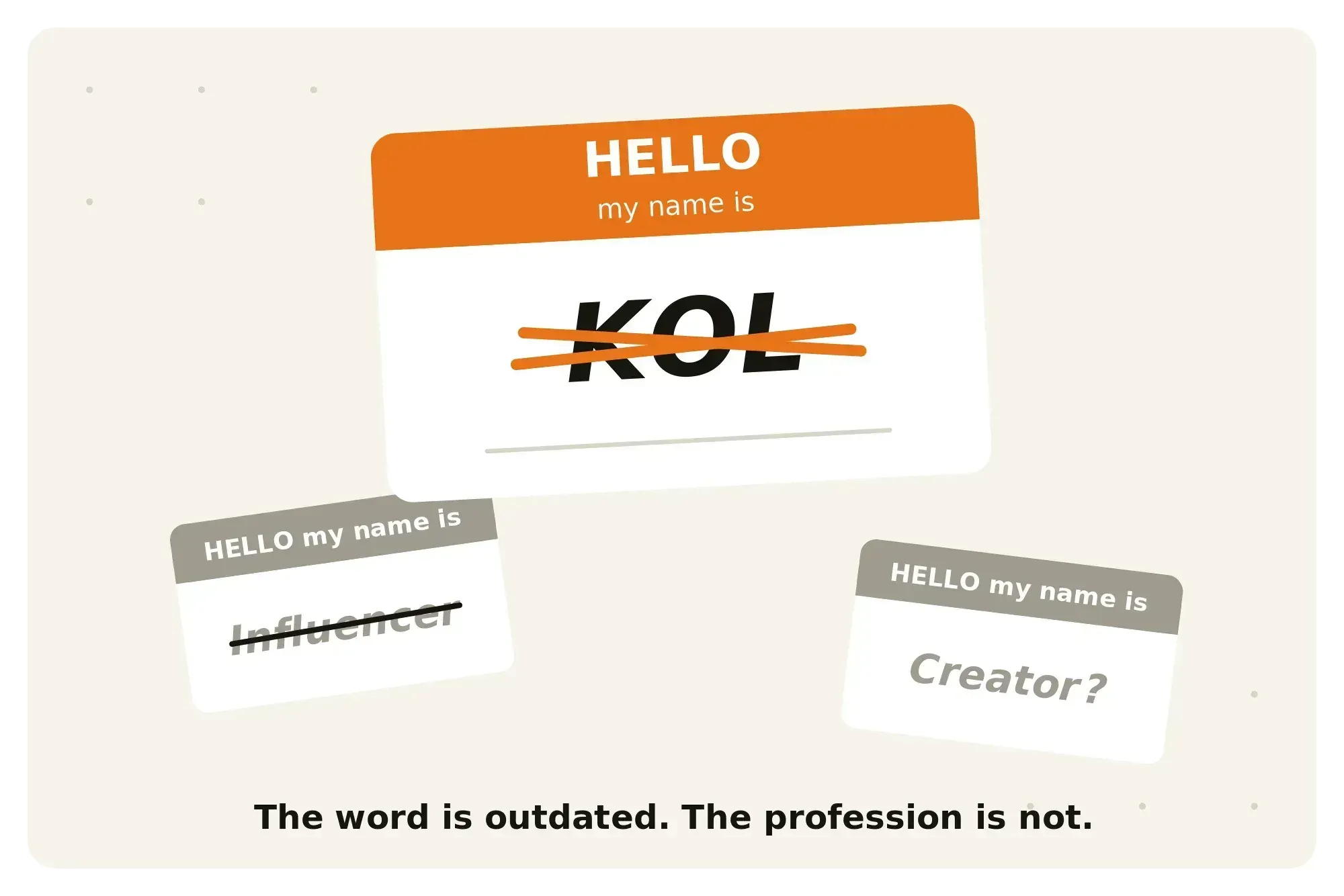
Ask someone outside crypto what a KOL is and you will get a blank stare. "Key Opinion Leader" sounds like a job title from a management consultancy.
Outside this industry, almost nobody uses the term.
Ask someone inside crypto and you will get a definition, usually followed by an opinion. The word has been around long enough to collect baggage:
- Too many projects treated KOLs as rented megaphones.
- Too many "KOL rounds" handed out discounted tokens in exchange for enthusiasm that expired the moment the unlock date arrived.
- Experienced operators hear the word and picture the worst version of the job.
Here is the uncomfortable part: none of the alternatives work either.
"Influencer" is the obvious candidate, and the people who do this work mostly refuse it. It describes a lifestyle economy of sponsored selfies and discount codes. That has very little to do with explaining a restaking protocol on YouTube.
"Creator" is closer. It is the word we reach for most at Lever. But it also covers cooking channels, gaming streamers, and woodworking TikTok. It tells you the person makes content. It tells you nothing about what they know.
So the industry, and Lever, keeps saying KOL, a word most of the world has never heard, for a profession that has outgrown it.
Because the profession is real, and it matters more every year.
Who These People Actually Are, And What Creators Do
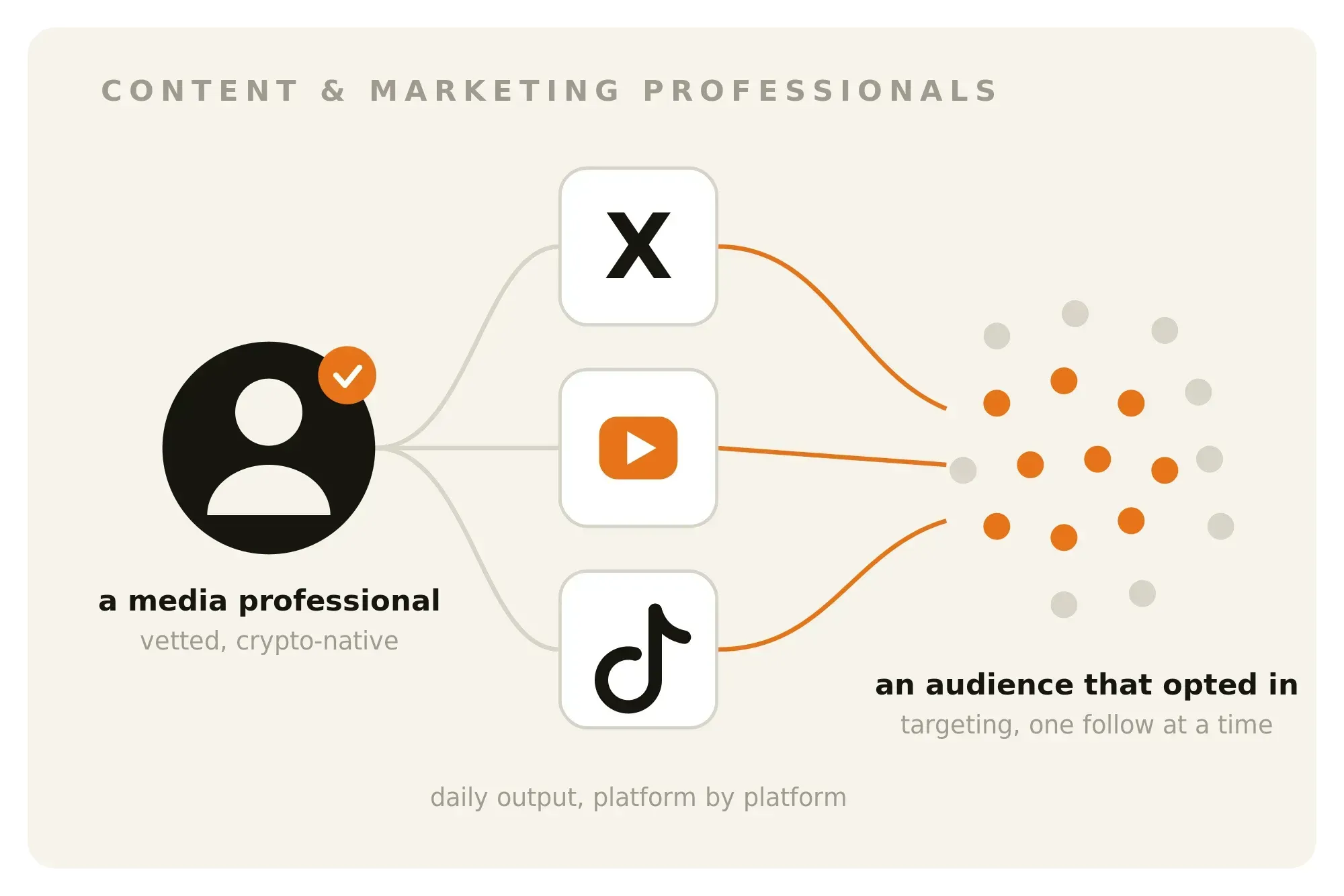
Lever works with several hundred people who work in media. Some built their audience on X, some on YouTube, some on TikTok.
What they have in common is that producing content for an audience is their job.
They are content and marketing professionals in the plainest sense of both words: they publish daily, they know their analytics cold, and their income depends on their audience continuing to trust them.
In Web3, that professionalism comes with a second layer of expertise that generalist media people simply do not have:
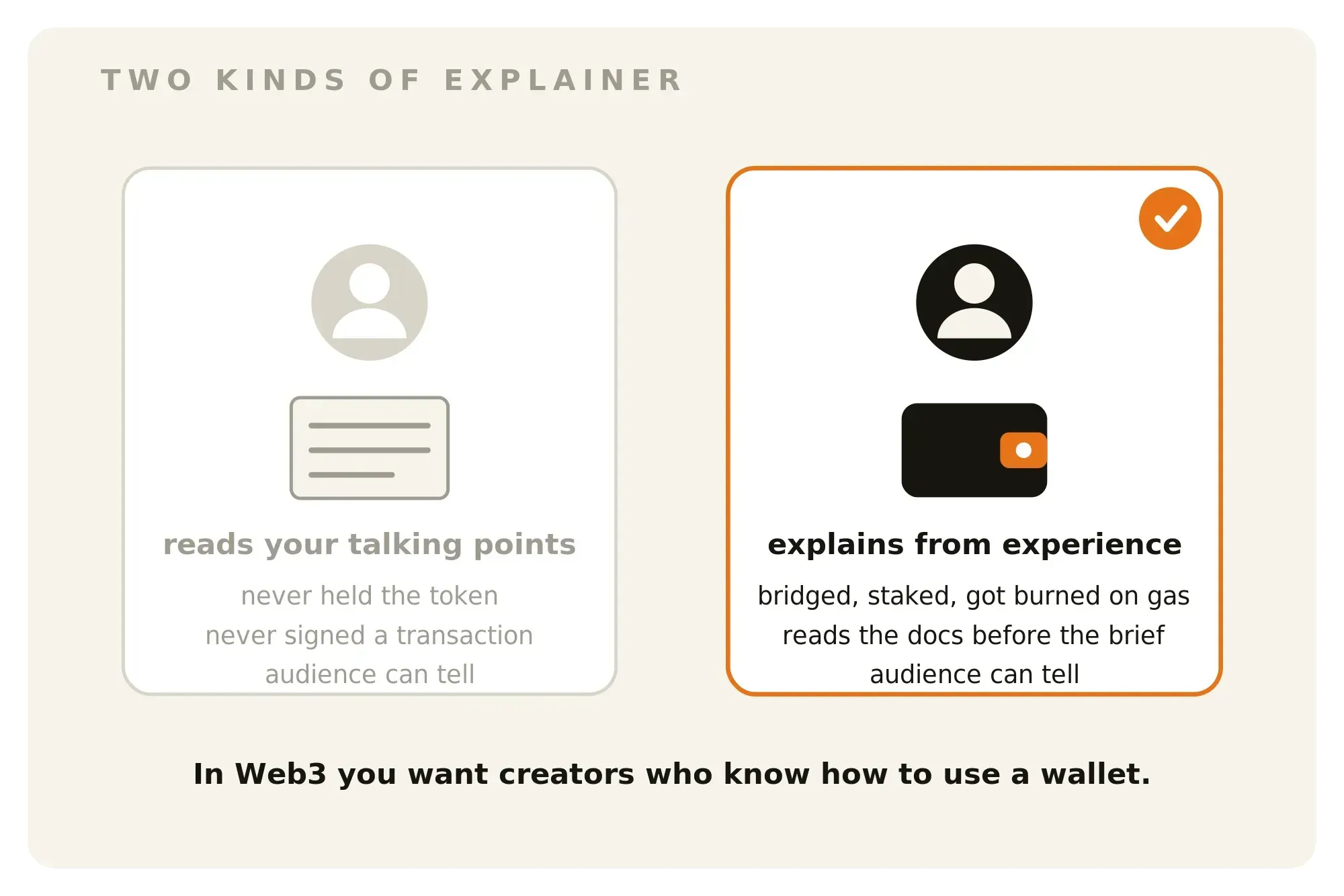
- These are people who know how to use a wallet.
- They have bridged assets, gotten burned on gas, held through drawdowns, and read enough documentation to tell a real product from a landing page.
- When they explain a protocol, the explanation comes from a place of true understanding, and their audience can tell.
That matters because of what the work actually involves:
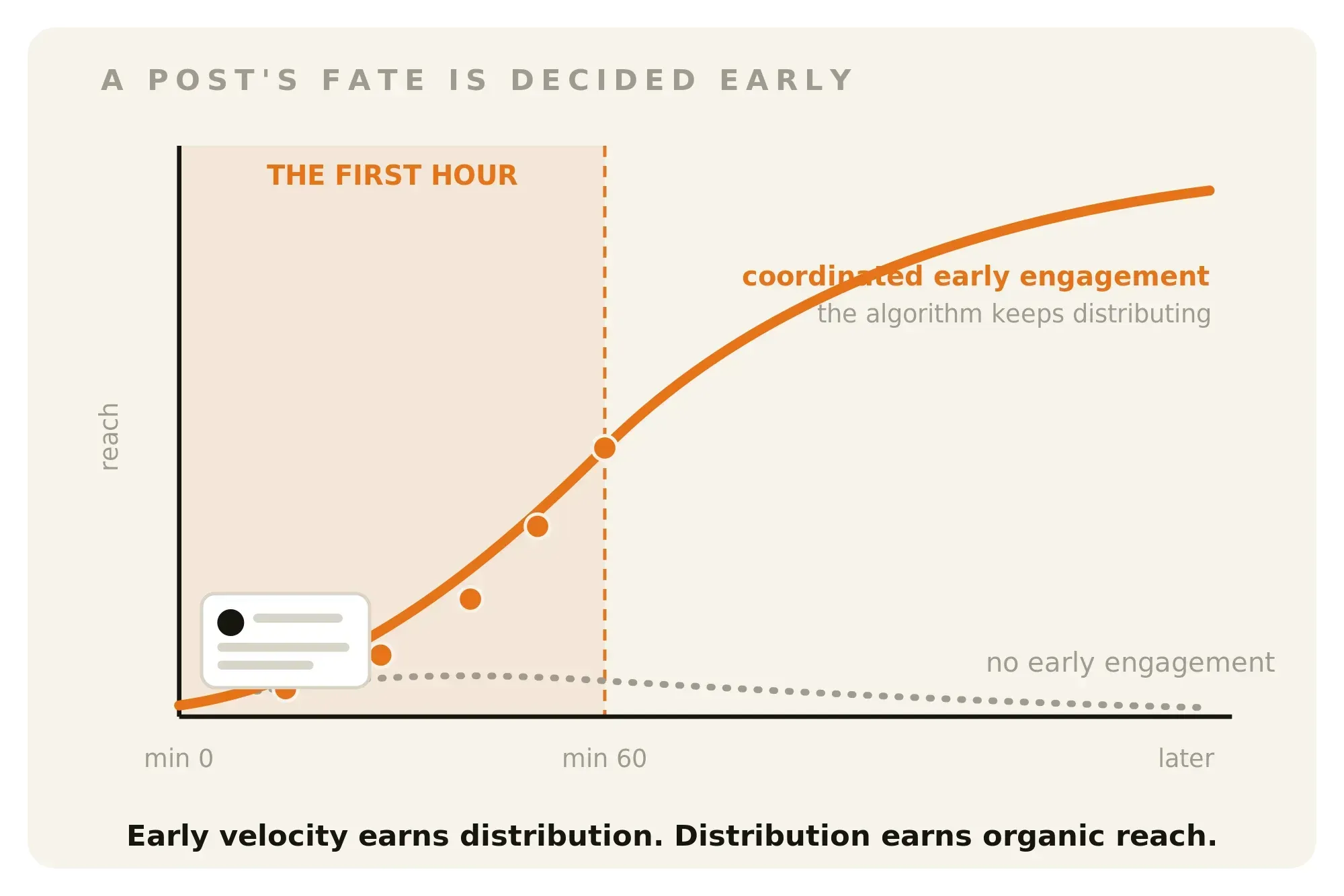
Moving the needle on a tweet in its first hour.
- A post's fate on X is decided fast. The algorithm watches early engagement and decides whether the post enters the wider timeline or dies in front of its existing followers.
- These professionals know how to get a message accepted by the X zeitgeist inside that window. We wrote about the mechanics of this in our piece on View Velocity.
Producing comprehensive video.
- A ten-minute walkthrough that takes a new user from "what is this" to a funded position is some of the hardest content to make in any industry.
- It requires the creator to actually use the product, hit the friction points, and explain them honestly.
Bringing a ready audience.
- A following is an audience that opted in. People subscribe to a DeFi researcher because they want DeFi research.
- When that researcher covers your protocol, your message reaches people who chose to be in the room. That is a form of highly targeted advertising, and it works because the targeting happened voluntarily, one follow at a time.
This is a new system of advertising and marketing, and it is still taking shape. Web3 needs it more than most industries.
The products are hard to explain, whether you are shipping a Layer 1 or a GameFi economy. The users are skeptical for good historical reasons.
And traditional ad channels have spent years restricting crypto anyway.
At Lever we describe the system in three words: create, syndicate, amplify.
- Each step looks simple from the outside.
- Each step eats an unreasonable amount of time when you try to do it well.
- And a team that fumbles any one of these three steps ends up with poor outcomes and no clear picture of which stage failed them.
Create: Quality Production Takes Longer than Anyone Budgets For
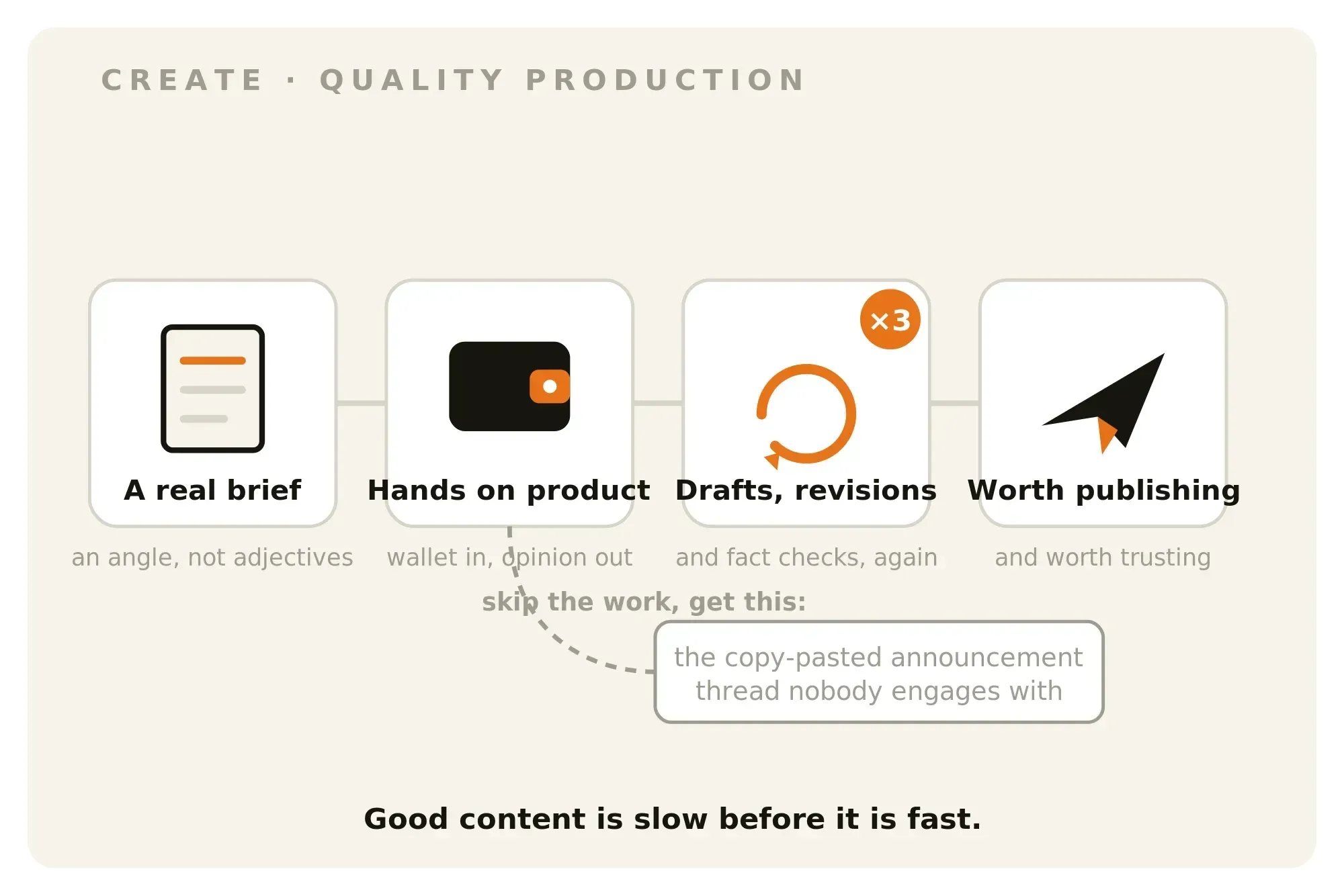
Good content starts before anyone hits record.
It starts with a brief that gives the creator a real angle instead of a list of adjectives, with product access so they can form an actual opinion, and with enough context about the audience to know what needs explaining and what doesn't.
Then comes the unglamorous middle: drafts, feedback, revisions, fact checks.
A creator who misstates how your protocol actually works has made you a liability, and it will sit on YouTube for years.
Everyone in this industry recognizes the failure mode, because everyone has seen it a hundred times:
- A generic thread that restates the project's announcement in slightly different words, posted into the void, engaging no one.
- That thread is what production looks like when the time was never spent.
- The audience scrolls past it, and worse, they remember the project that paid for a cheap shill.
We covered what serious campaign preparation looks like in our campaign guide.
The short version: the projects that get great content are the ones that treat creators like professionals with a craft, not like ad inventory with a face.
Syndicate: One Good Post Dies Without Support
Suppose your content is excellent.
A single excellent post still disappears in hours. The timeline moves on, the video slips down the feed, and a week later there is no trace the campaign happened.
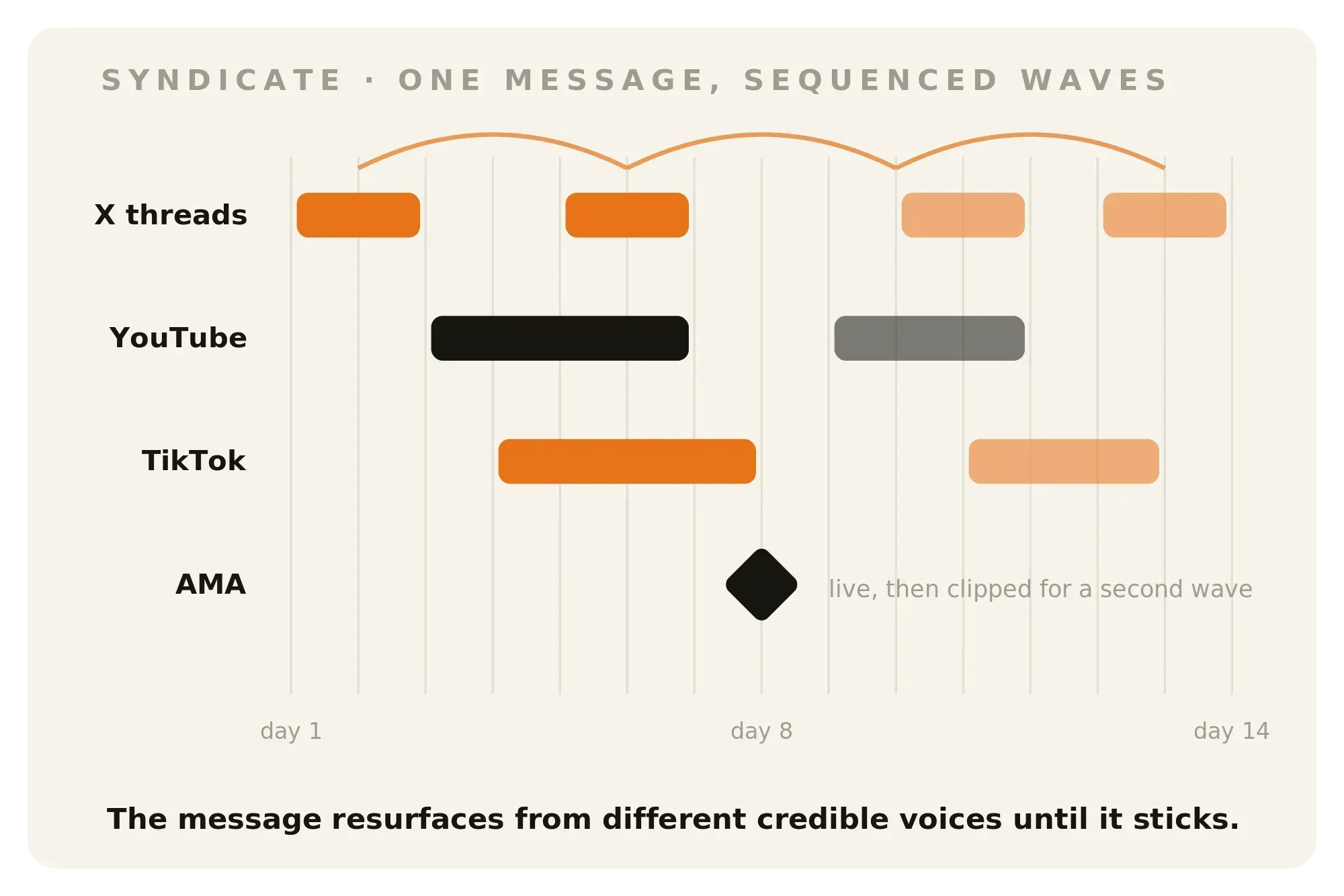
Syndication is the answer, and it is a coordination problem before it is anything else. Multiple creators, multiple platforms, multiple formats, sequenced so that the message keeps resurfacing in front of the same audience from different credible voices.
A thread primes the topic, a video deepens it, an AMA answers the questions the video raised, and follow-up posts catch the people who missed the first wave.
Getting that sequence right means scheduling dozens or hundreds of independent professionals, each with their own calendar, their own content pipeline, and their own opinions about timing.
It is logistics work, it is unending, and it is precisely the work most marketing teams have no capacity for.
When it comes together, the effect is hard to argue with. In a recent campaign, 75 creators produced 186 pieces of content across a 14-day sprint, and the token sale they supported landed among the largest auctions Uniswap has ever run.
None of those creators could have produced that outcome alone. The sequencing was the product.
Amplify: The First Hour is Won in the Replies
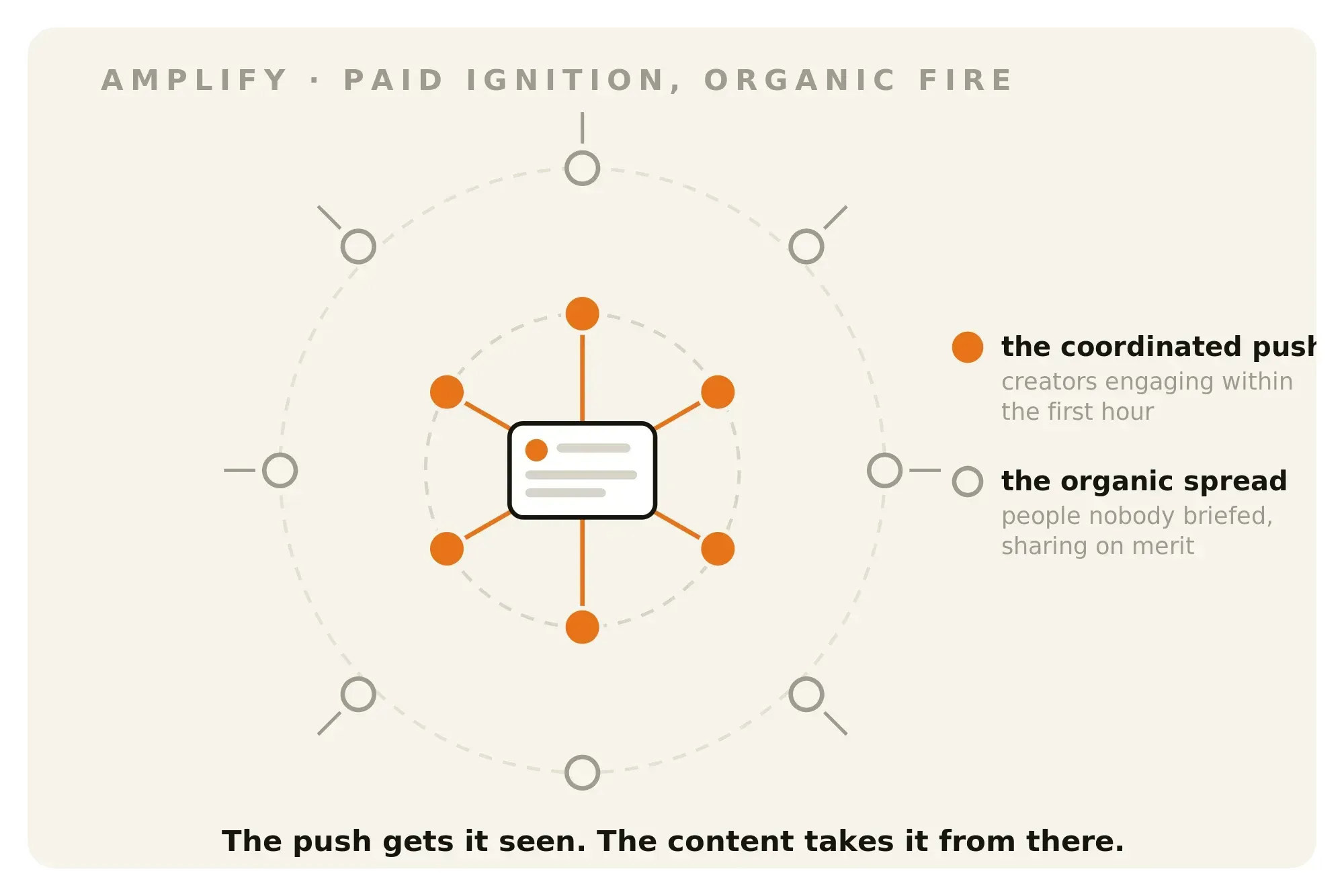
Amplification is the least visible pillar and the one we get asked about least, which is a shame, because it is often the difference between a campaign that travels and a campaign that stalls.
Here is the mechanism:
- When a key post goes live, its first hour decides its reach.
- Engagement in that window tells the algorithm the post deserves distribution.
- So when Lever runs a campaign, a wave of creators is ready to engage within hours of a signal, and sometimes within minutes: quote posts, replies, discussion, honest reactions from accounts the algorithm already trusts.
- Nights and weekends included, because token launches do not respect office hours.
Coordinating that wave is a staggering amount of communication. It is Telegram messages back-and-forth with dozens of creators across time zones, confirming timing, sharing context, answering questions, adjusting when the schedule slips.
Somebody has to do the talking, and the talking takes tons of time.
- The payoff is what happens after the window:
- Early velocity is what earns a post its organic spread.
- The algorithm cannot reward content it never surfaces, and it surfaces content that proves itself early.
The coordinated push gets the message seen; from there, it travels on its own merit, shared by people nobody briefed and nobody paid.
The push is the ignition.
The virality is organic.
Both statements are true, and understanding how they fit together is most of understanding modern distribution.
One more thing, because it has to be said in any honest piece about amplification: this only works with real accounts.
Fake engagement gets detected, discounted, and eventually punished by every platform.
Lever audits its own roster on-chain and removes accounts that fail, because a distribution network is only worth what its accounts are worth.
The Marketing Multiplication Problem: Solved by Lever.io
Here is the part that catches teams who try to run this in-house.
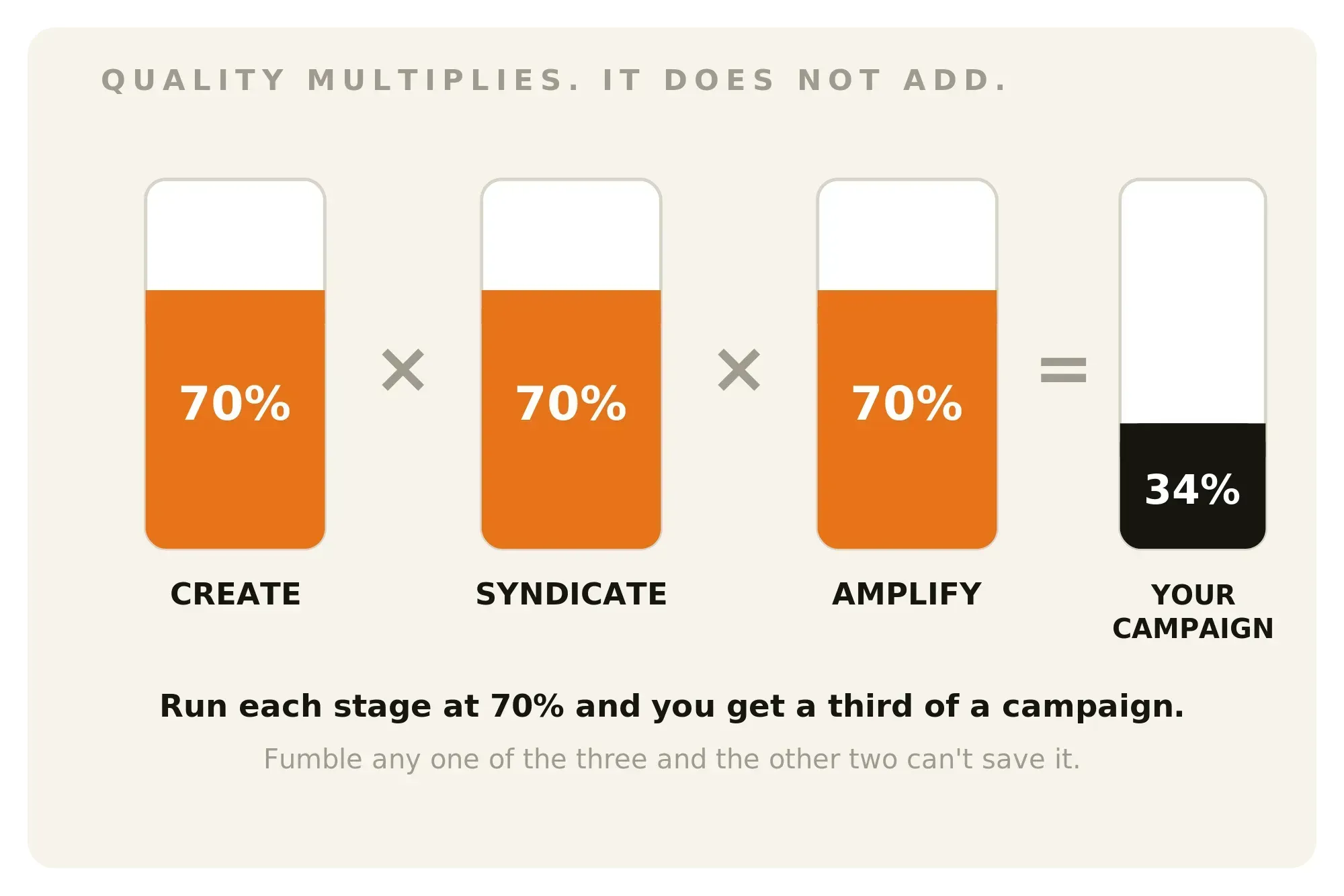
Production, syndication, and amplification do not add. They multiply.
- Great content with weak syndication reaches nobody.
- Perfect sequencing of mediocre content spreads a message no one cares about.
- Strong content, well sequenced, with no amplification, loses the first hour and never gets its chance.
Do each stage at 70% and you do not get 70% of a campaign. You get a third of one.
Most teams learn this the expensive way.
They spend a quarter recruiting creators one DM at a time, wrestling schedules, chasing late posts, and watching content go live to silence. The budget is spent, the outcome is poor, and the post-mortem cannot even identify which of the three stages broke.
This is the entire reason Lever exists.
Several hundred vetted media professionals, already onboarded, already audited, already used to working in coordinated waves.
Production, syndication, and amplification handled by a team that does nothing else, so it gets done right the first time, whether you are months from launch or live and scaling.
The word "KOL" will probably fade. The profession behind it is just getting started, and the projects that understand how to work with it are going to be very hard to compete with.
See how a Lever campaign comes together, or talk to us about your next one.