
Robinhood Chain Is Live. The L2 War Is Now a Distribution War.
A tradfi incumbent just shipped a permissionless chain and bootstrapped a DeFi ecosystem in a week. The lesson for everyone else is uncomfortable.

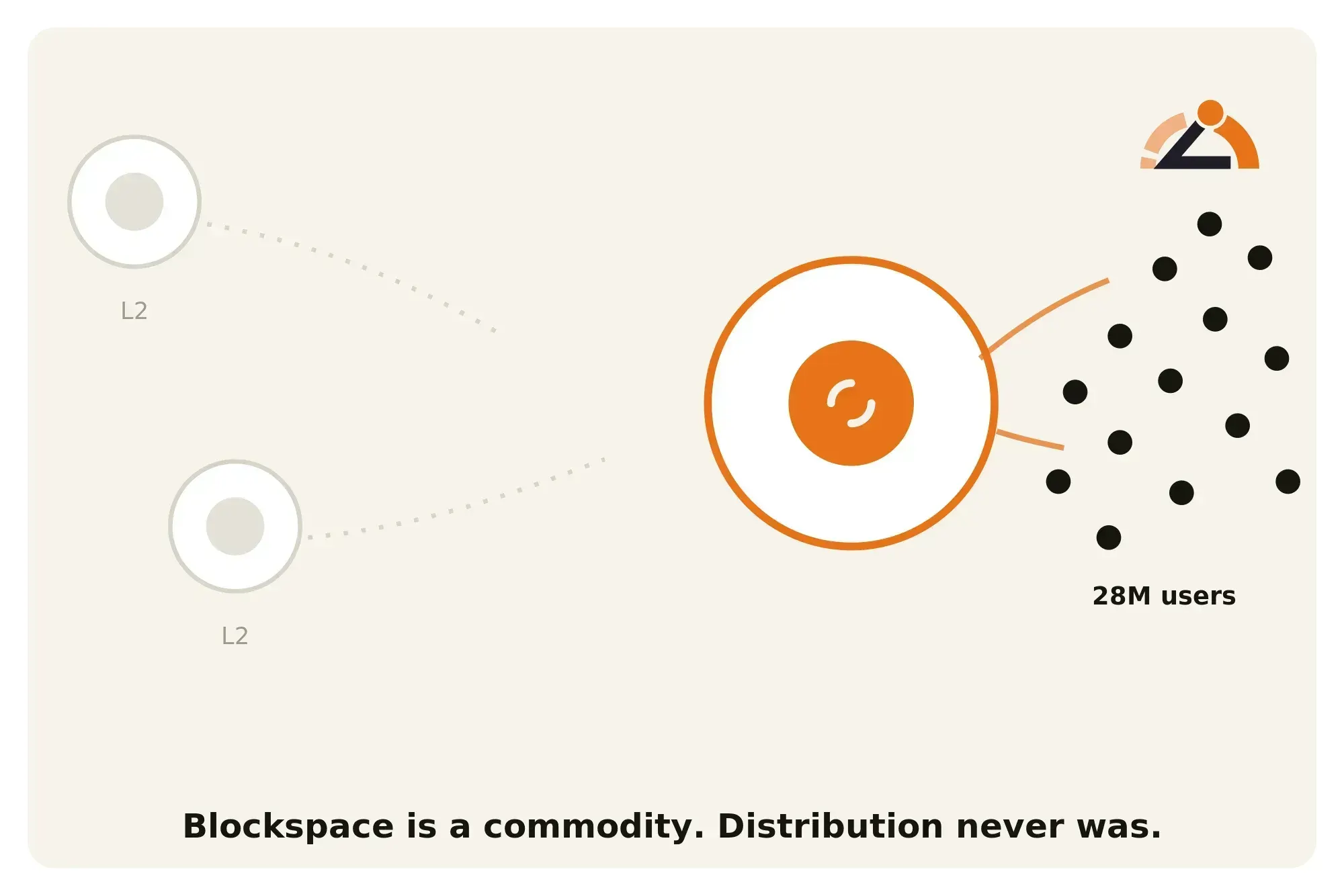
On July 1, from a stage in London, a NASDAQ-listed brokerage flipped the switch on a public blockchain.
Robinhood Chain is live, and it's a permissionless Layer 2 where anyone can deploy.
And two weeks in, it is already the most instructive case study of 2026.
What Actually Launched on Robin Hood
The launch, unveiled at Robinhood's "The World is Flat" keynote, was bigger than most people registered.
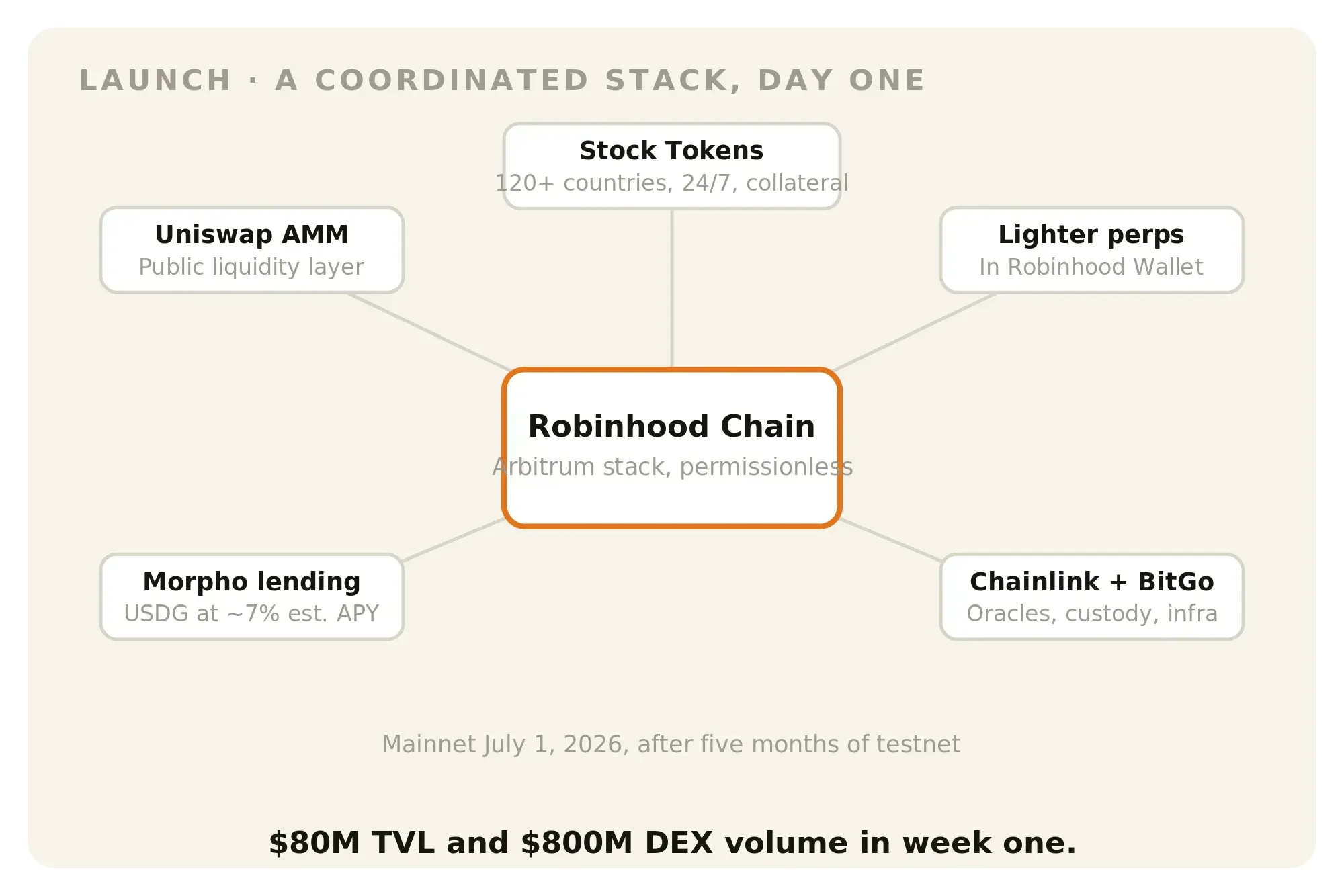
The chain itself, built on Arbitrum's stack after about five months on testnet, is one piece of a coordinated stack:
- Stock Tokens live in more than 120 countries through Robinhood Wallet, tradeable 24/7 and usable as DeFi collateral.
- A day-one DeFi ecosystem: a dedicated Uniswap AMM as the public liquidity layer, Pleiades running a proprietary AMM, and perpetuals through Lighter.
- Robinhood Earn, lending USDG through the Morpho protocol at an estimated 7% APY, insured through Lloyd's of London.
- Institutional plumbing from Chainlink, BitGo, and Alchemy, wired in from the start.
Early traction followed fast.
The DefiLlama dashboards tracked more than $80 million in TVL, over $200 million in stablecoins bridged, and roughly $800 million in cumulative DEX volume within the first week.
For a chain that is fourteen days old, in this market, those numbers deserve attention.
And the chain was one announcement among many.
The same keynote covered agentic accounts that let US traders wire AI models directly into Robinhood's trading stack, perpetual futures on commodities and FX for Europe, and expansion into Canada and the UK.
CoinDesk calls this the race for the "everything exchange," every kind of trading under one roof, increasingly on blockchain rails.
Most L2s spend a year and a nine-figure incentive budget chasing what Robinhood Chain pulled in before its first weekend was over.
The Word That Matters Is Permissionless
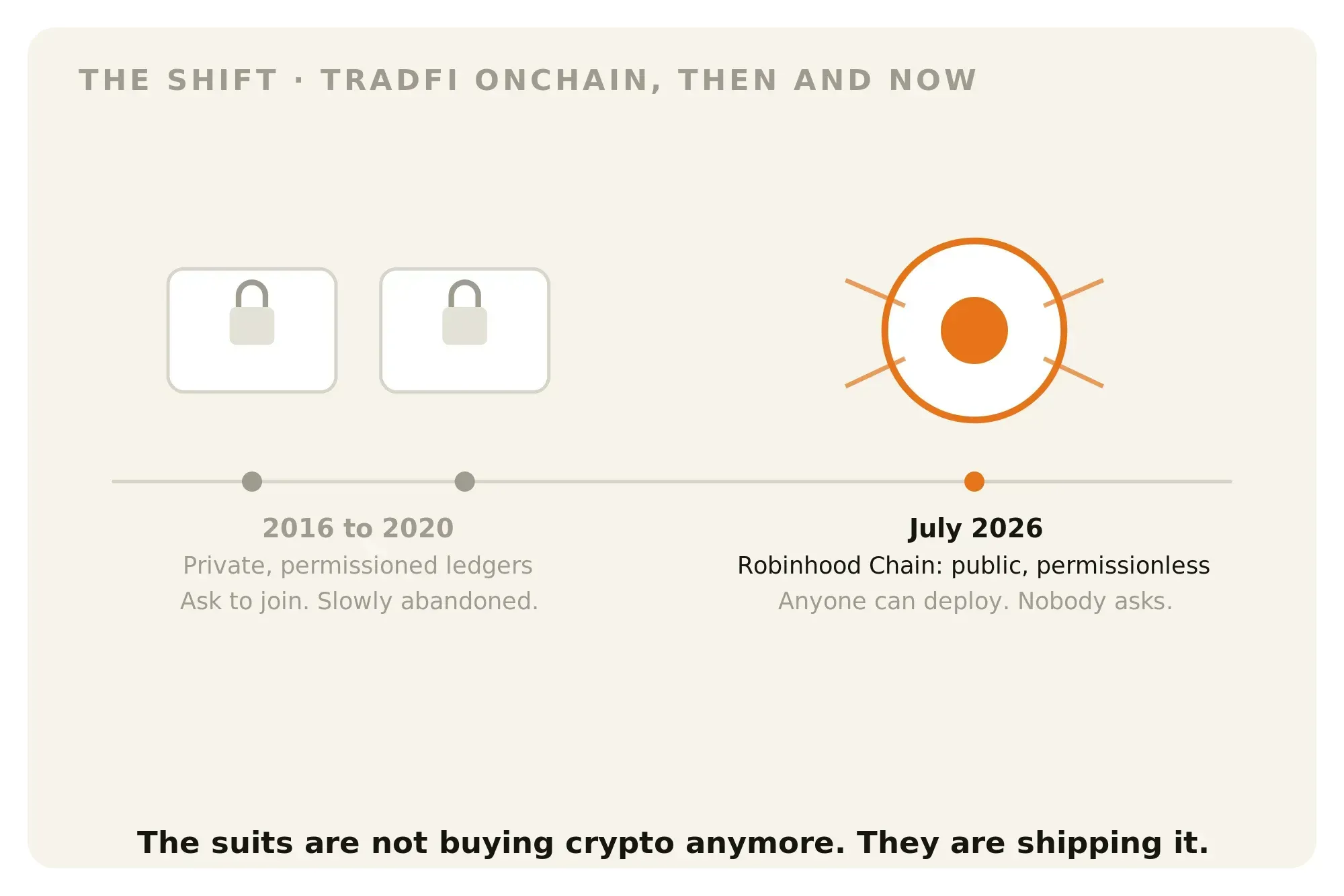
TradFi has flirted with blockchains for a decade.
The pattern was always the same: a private, permissioned ledger, a press release about efficiency, and slow abandonment two years later.
JPMorgan built one. So did a long list of consortium projects whose names nobody can recall.
They failed for the same reason intranets lost to the internet: a network you must ask to join is not a network, it is a database with better branding.
This is different in kind, and the difference is one word.
Robinhood Chain is permissionless.
Any developer can deploy contracts on rails operated by a regulated, publicly listed brokerage.
Johann Kerbrat, who runs crypto at Robinhood, framed the goal as bringing the best of traditional finance and DeFi together.
Three years ago, a compliance department would have laughed that sentence out of the building.
The thaw has been coming. We covered how the GENIUS Act rewired what regulated companies can do onchain, and the tokenization race has since gone institutional: CoinDesk reports that Nasdaq and the owner of the NYSE are working to put the $126 trillion equity market on blockchain rails.
A permissionless chain from a tradfi incumbent is the strongest signal yet that the regulatory chill is over.
The suits are not buying crypto anymore.
They are shipping it.
The L2 War Stopped Being About Technology
Robinhood did not launch into empty space.
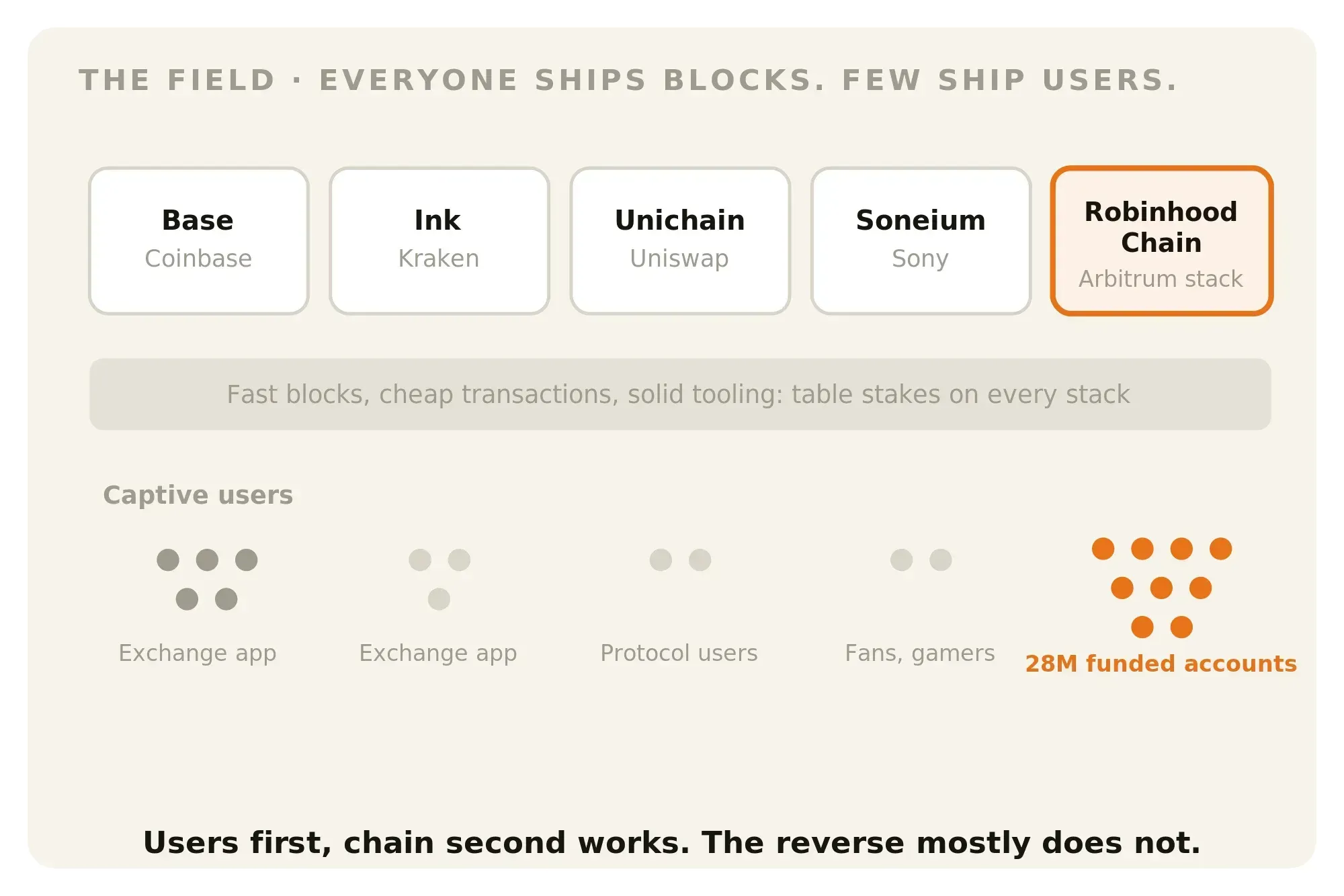
It launched into a crowded field of corporate chains: Coinbase has Base, Kraken has Ink, Uniswap has Unichain, Sony has Soneium, World has World Chain.
Base alone holds roughly half of all L2 DeFi TVL, and The Block's 2026 Layer 2 outlook reads the field the same way we do: rollups have evolved from scaling experiments into distribution networks, where access to users and capital beats marginal performance gains.
Blockspace became a commodity. Every serious stack offers fast blocks and cheap transactions. What none of them can conjure is people.
Robinhood Chain launched with 28 million funded accounts natively connected to it.
That is the whole game.
Coinbase proved it first: Base won its position not on benchmarks but on a warm handoff from an exchange app that already lived on millions of phones. Robinhood just ran the same play with a brokerage.
Even the stack choice reads as a distribution decision.
While Kraken, Sony, and World standardized on Optimism's Superchain, Robinhood built on Arbitrum, whose DeFi depth and tooling matter more to the lending and perps products it shipped on day one.
Between them, Base and Arbitrum already carry over three quarters of L2 DeFi value. Robinhood picked the rails its products needed, not the logo its peers picked.
Compare the launches nobody remembers.
Dozens of technically excellent L2s shipped over the past three years, spent enormous sums on liquidity incentives, and stalled the moment the emissions dried up, because incentives rent users and distribution has to be earned with attention.
Users first, chain second works. Chain first, users maybe does not.
Tokenized Equities Are Robinhood's Beachhead
The asset story matters as much as the chain story, because tokenized stocks became crypto's most contested product category this year.
Kraken's xStocks passed 100 listed tokens and $25 billion in cumulative transaction volume. Coinbase and Binance announced rival products within a day of each other in March.
The spot market is still small, under half a billion dollars by one count at the end of Q1, while RWA perpetuals turned over hundreds of billions in the same quarter.
Translation: demand for onchain equities exposure is real, and the venues are still up for grabs.
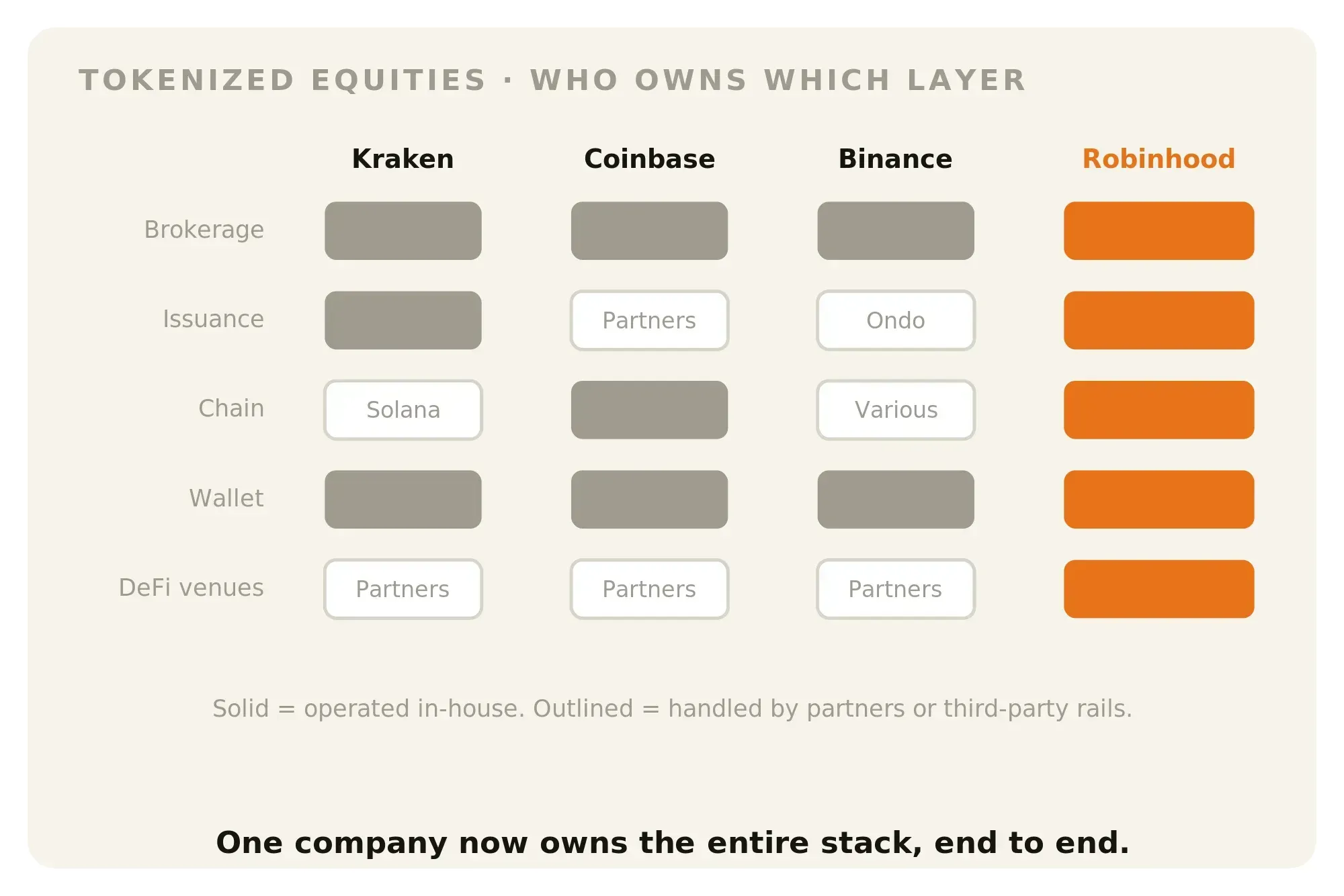
Robinhood's position in that race is structurally different. Kraken issues tokens on Solana. Coinbase plugs into partners. Binance leans on Ondo.
Robinhood owns every layer: the brokerage, the token issuance, the chain, the wallet, and the DeFi venues on top.
A customer can buy a Stock Token, post it as collateral, lend against it, and trade perps without leaving rails that one company operates end to end.
Whether regulators stay comfortable with that vertical stack is a real question. As strategy, it is the most aggressive move any tradfi company has made onchain.
Honest caveats belong in any real analysis. Stock Tokens are debt instruments issued from Jersey that track prices without conferring shareholder rights, US customers cannot touch them, HOOD trades well below its October high, and the company cut a tenth of its workforce last month.
The launch is a bet, not a victory lap.
But it is a bet placed with conviction, into a down market, which is exactly when the edge is cheapest.
If You Are Not Robinhood, You Have a Distribution Problem
Here is the uncomfortable arithmetic underneath everything above.
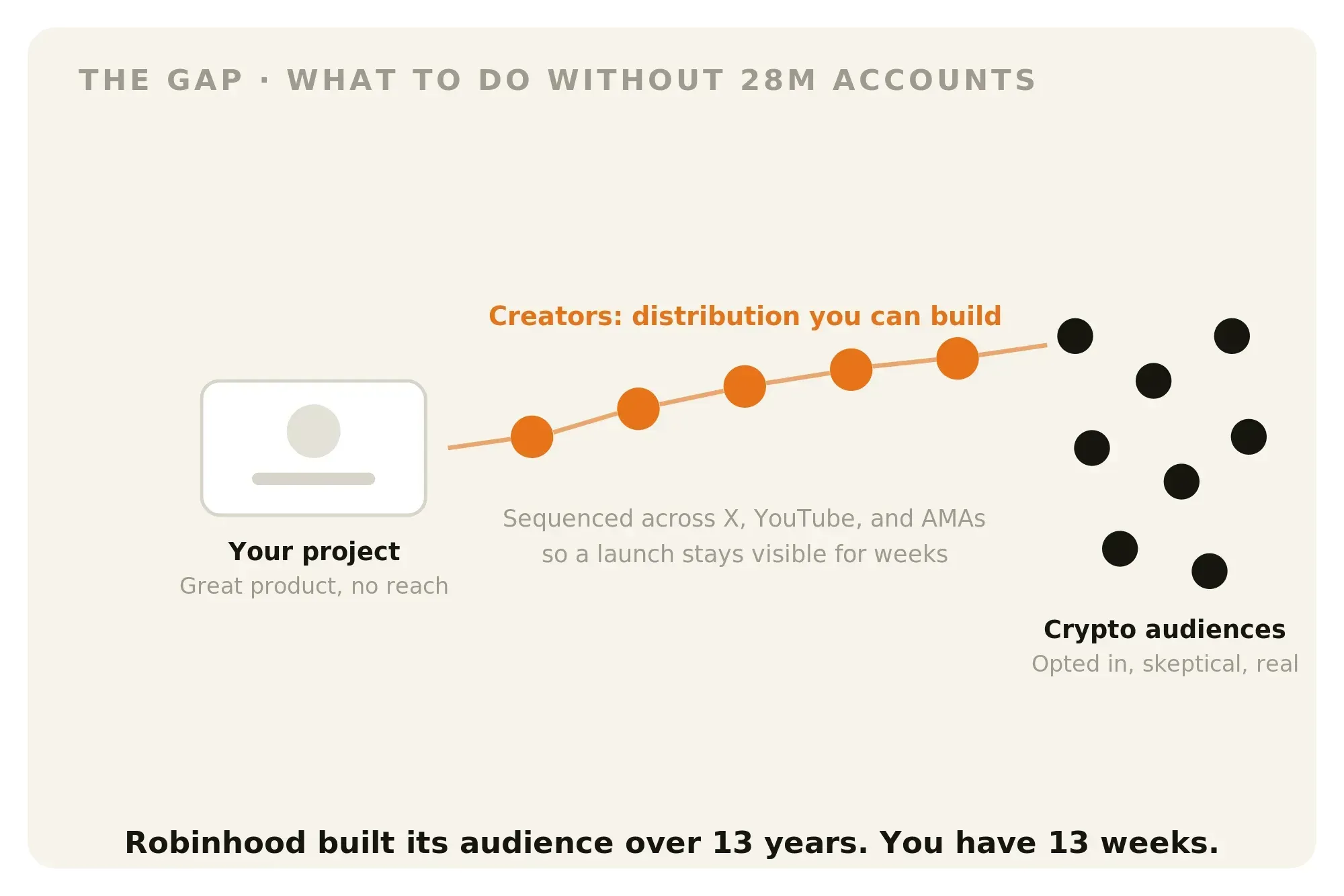
Robinhood can launch a chain into a bear market and watch a DeFi ecosystem materialize in a week, because 28 million people were already standing there when the doors opened. Almost nobody else gets that head start.
If you are building a Layer 1 or Layer 2 without a captive audience, distribution is not a line item in your launch plan. It is the launch plan.
The same holds one level down. The DeFi protocols deploying on Robinhood Chain, Base, or Solana inherit blockspace, not attention. Uniswap and Morpho earned their day-one slots through years of being impossible to ignore.
Manufactured distribution, done honestly, is creators. Wallet-native media professionals with audiences that opted in, sequenced across platforms so a launch stays visible for weeks instead of trending for an afternoon.
That means threads and quote waves on X, walkthroughs on YouTube, AMAs that answer the hard questions in public.
We at Lever have watched this work at launch scale.
A recent Lever campaign put 75 creators and 186 pieces of content behind a token sale in 14 days, and it landed among the largest auctions Uniswap has ever hosted. That was manufactured distribution for a project that did not have 28 million accounts to lean on.
The window logic runs the same direction too.
Robinhood is marketing into the downturn while most projects hibernate, which means every dollar of attention is cheaper and every credible voice is easier to book, whether you are months from mainnet or mid-launch.
Robinhood built its audience over thirteen years.
You probably have thirteen weeks.
That gap is closable, but not by accident, and not for free. It takes a structured campaign with targeted reach into the audiences that matter.
The chains that understand this are already moving. The ones that still think the tech sells itself are about to learn what Robinhood just taught everyone.
Blockspace is a commodity. Distribution never was.