
Privacy Is the Only Sector Winning in 2026. Here's How to Market It Without the 2017 Baggage.
Privacy is the one sector actually working in 2026, and the 2017 marketing playbook is the fastest way to ruin it. Here is the campaign structure that fits the moment.

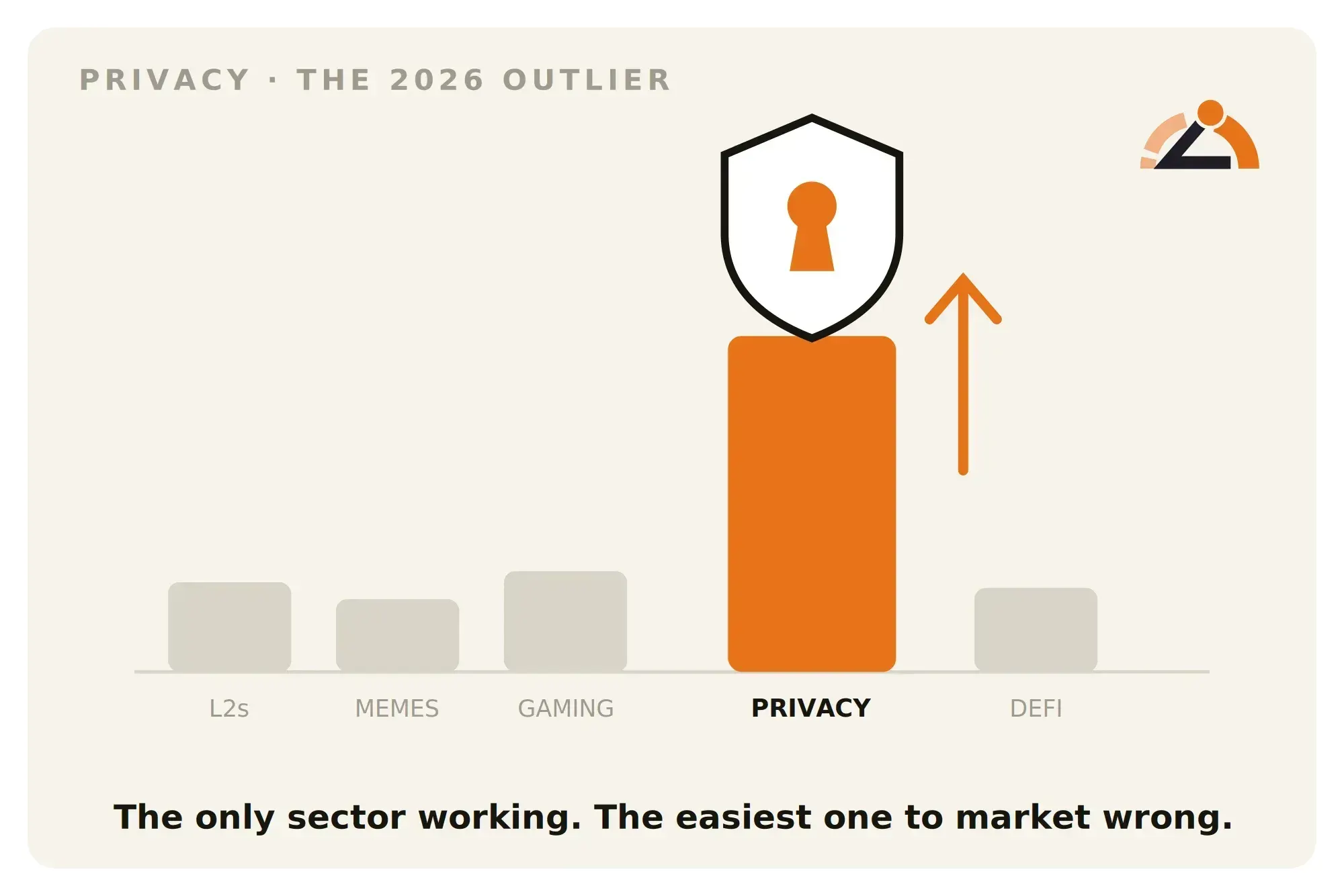
Most of crypto has spent 2026 digesting. Majors are chopping sideways, altcoin dominance sits at multi-year lows, and every timeline is arguing about whether this accumulation window is a gift or a trap.
One sector didn't get the memo.
Privacy is the standout performer of the year, and for once the strength is showing up in usage data rather than pure narrative.
That makes it the most interesting marketing problem in crypto right now, because the old privacy-coin playbook is precisely the thing that could break the run.
If you're building in this sector, the way you market over the next six months matters more than it does for almost anyone else. Here's why, and what to do about it.
The Numbers Behind the Privacy Run
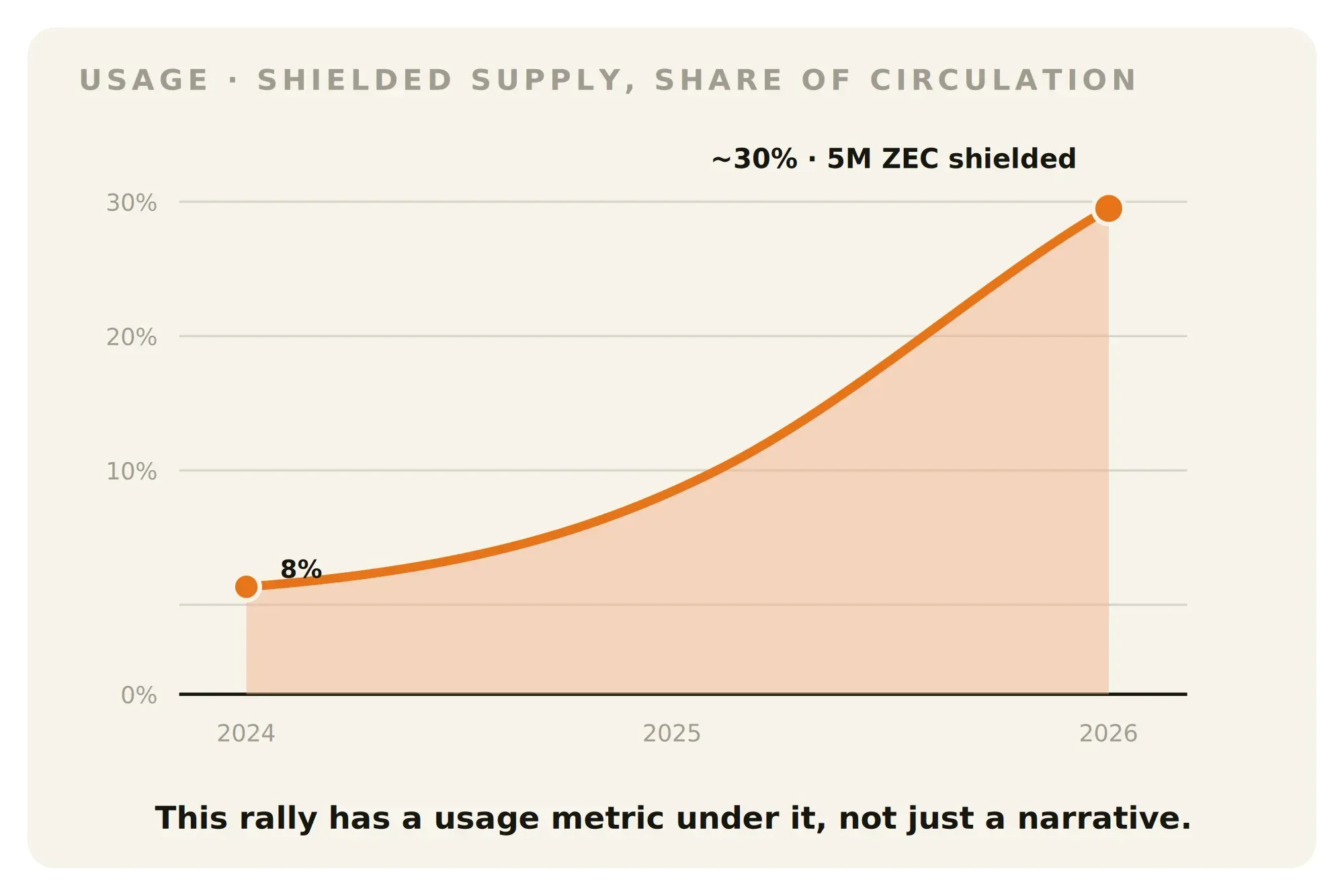
Start with Zcash, the sector's reference asset. Shielded supply has grown from roughly 8% of circulation in early 2024 to around 30% today, about five million ZEC deliberately moved into private addresses.
That's a usage metric, not a trading metric. Coins sitting on an exchange contribute nothing to it.
The regulatory picture flipped at the same time. The SEC closed its Zcash review in January 2026 with no enforcement action.
Grayscale filed for a spot ZEC ETF, which would be the first privacy-asset ETF in the US. Robinhood listed the asset. Sanctions attitudes softened across the board.
And behind the coins, an infrastructure wave is forming. Fully homomorphic encryption teams like Zama, Fhenix, and Arcium on Solana are shipping confidential-compute rails that let applications process encrypted data without ever decrypting it.
Privacy stopped being a coin category and started becoming a stack.
The sector re-rated because it grew up, and the marketing that fits a grown-up sector looks nothing like what privacy projects used to run.
2017 Wants to Run Back It's Playbook. Don't.
The classic privacy-coin marketing formula was simple: lean into the outlaw energy. "Untraceable." "They can't see you." Hoodie graphics, surveillance-state memes, a wink at the darknet.
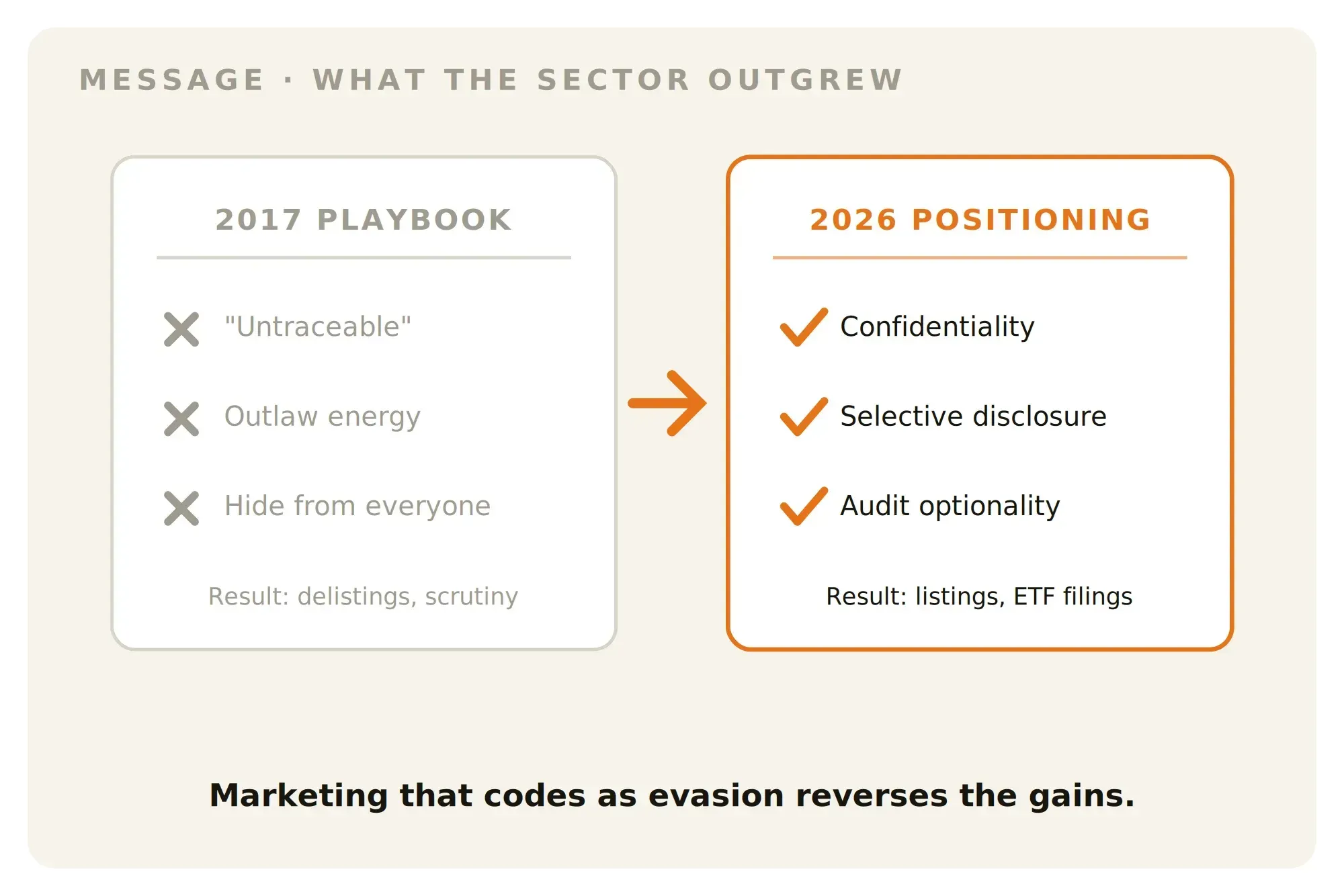
That formula got privacy assets delisted from half the world's exchanges, and it's exactly wrong for 2026.
Look at what actually drove the re-rating: an SEC review closed without action, an ETF filing, institutional accumulation, and a "privacy is normal" framing that repositioned confidentiality as standard financial hygiene rather than evasion.
Every one of those gains is reversible, and marketing that codes as evasion is how you reverse them.
We watched the same dynamic play out with stablecoins. For years the sector marketed with one hand tied behind its back, then the GENIUS Act changed what was sayable and the projects with disciplined messaging captured the moment.
Privacy is at the same inflection point, except the stakes are higher because the sector's whole history is a compliance scar.
The 2026 version of privacy messaging talks about confidentiality, selective disclosure, and audit optionality.
It can face a CT native and a compliance officer in the same thread.
If a campaign concept would make your counsel wince, it will eventually make an exchange listing team wince too.
What Works: Education First, Measured Properly
Privacy tech has a real problem that most crypto verticals don't: it's genuinely hard to explain.
Shielded pools, zero-knowledge proofs, FHE. The buyer needs to understand the mechanism before the value proposition means anything.
That makes this an education-first sector, and education content has a known failure mode: nobody can tell whether it landed.
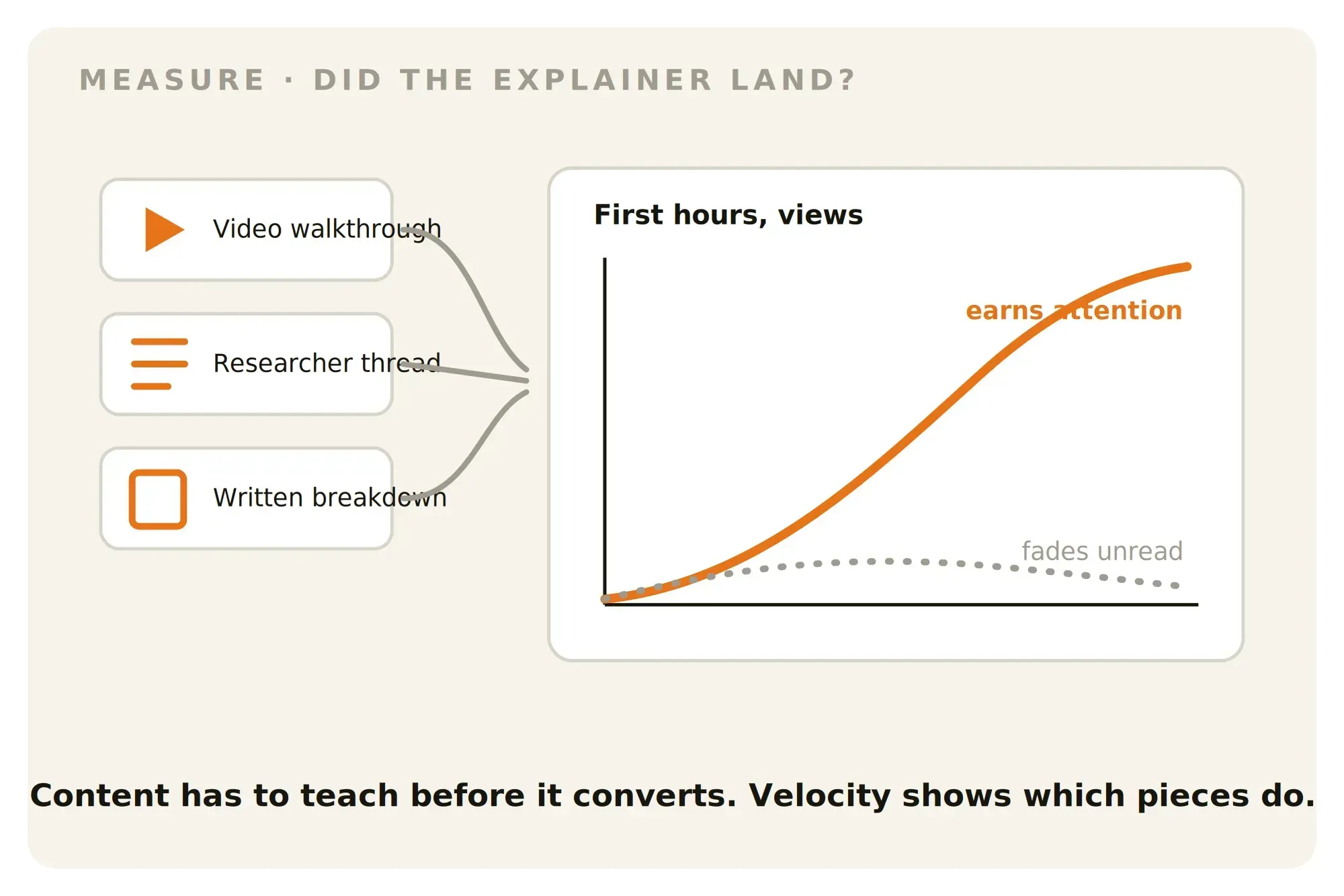
A long-form YouTube explainer or a researcher thread on X either earns real attention in its first hours or it dies unread, and follower counts won't tell you which happened.
This is what View Velocity was built for: measuring how efficiently a creator converts output into actual attention, so you can see whether your explainer content is compounding or evaporating.
For a sector where the content has to teach before it can convert, that measurement is the difference between a strategy and a hope.
The creator profile matters just as much as the format. Privacy audiences are the most skeptical in crypto, which is saying something.
They respond to creators with technical credibility, the zk researchers and DeFi analysts who can walk through a shielded transaction on camera, and they punish generalist accounts reading a brief.
A bundle of credible mid-size voices will outperform one large account here by a wide margin, which is the same micro-creator and long-term deal logic reshaping the rest of Web3 marketing.
Long-term deals fit this sector especially well.
Trust is literally the product. A creator who covers your protocol across six months of upgrades reads as conviction. A one-off post reads as a transaction.
Why Yap-to-Earn Would be Lethal Here
If there's one sector where the InfoFi model should never come back, it's this one.
Yap-to-earn collapsed because it paid for volume of mentions and got exactly that: spam, engagement farming, and a flood of low-effort posting that buried the projects it was supposed to promote.
Run that model on a privacy protocol and you generate the precise signal regulators and serious holders are primed to read as a red flag: coordinated low-quality hype around an asset class with a history.
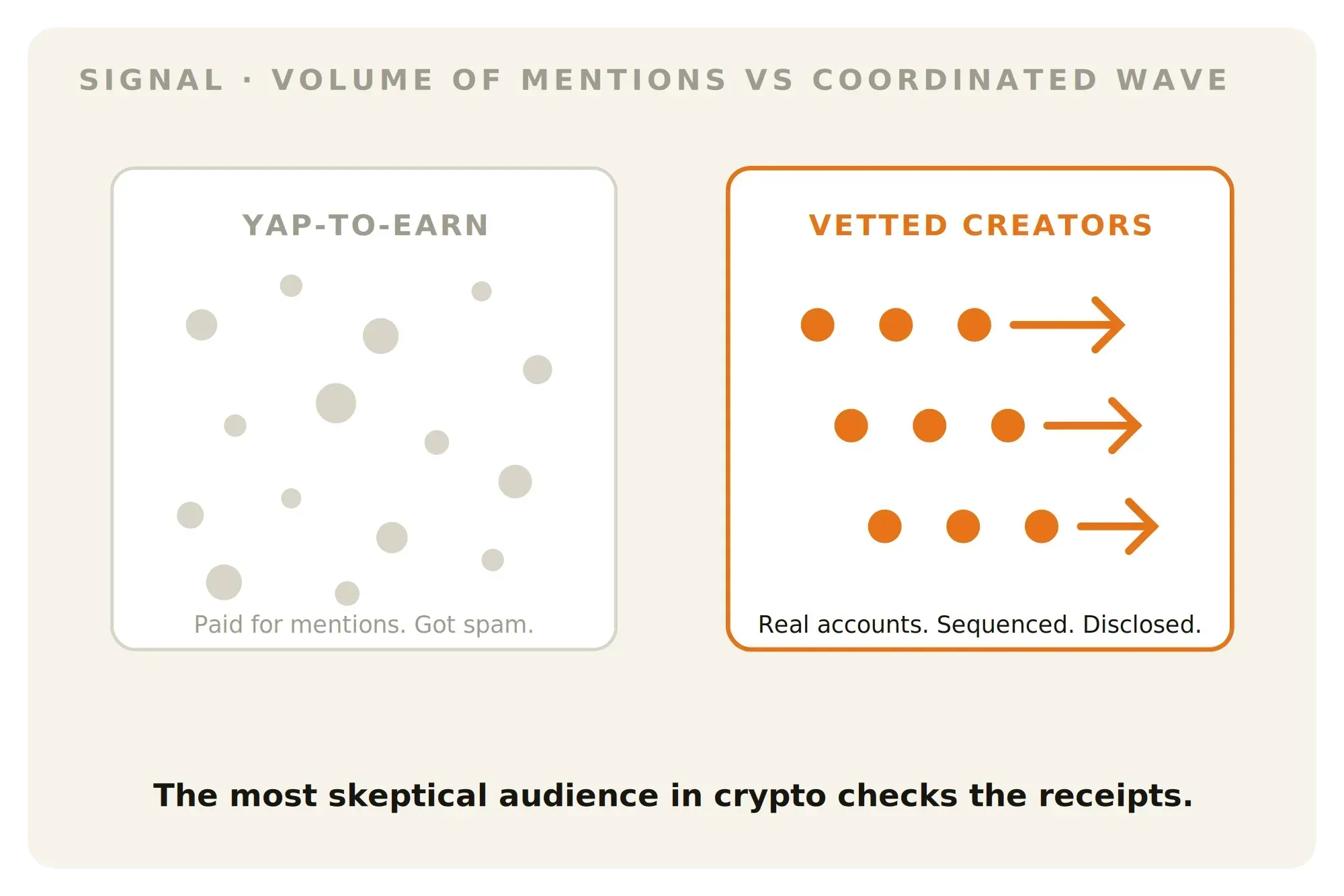
Fake engagement carries the same asymmetric risk. Privacy audiences check.
They're the crowd most likely to pull the on-chain receipts on a botted campaign, and one exposed sybil wave costs more credibility than ten clean campaigns build.
It's why roster auditing and fraud detection can't be an afterthought in this vertical. Every account in a privacy campaign has to be real, because the audience treats verification as a sport.
The honest frame, the one we use for every campaign, holds up fine here: the coordinated push is paid and disclosed, the ignition is manufactured, and the organic spread it earns afterward is real.
In privacy, disclosure is a feature. The audience that values transparency about data flows also values transparency about who paid for the post.
How to Structure a Privacy Campaign Right Now
The structure that fits this moment runs in three phases, and the sequencing does most of the work.
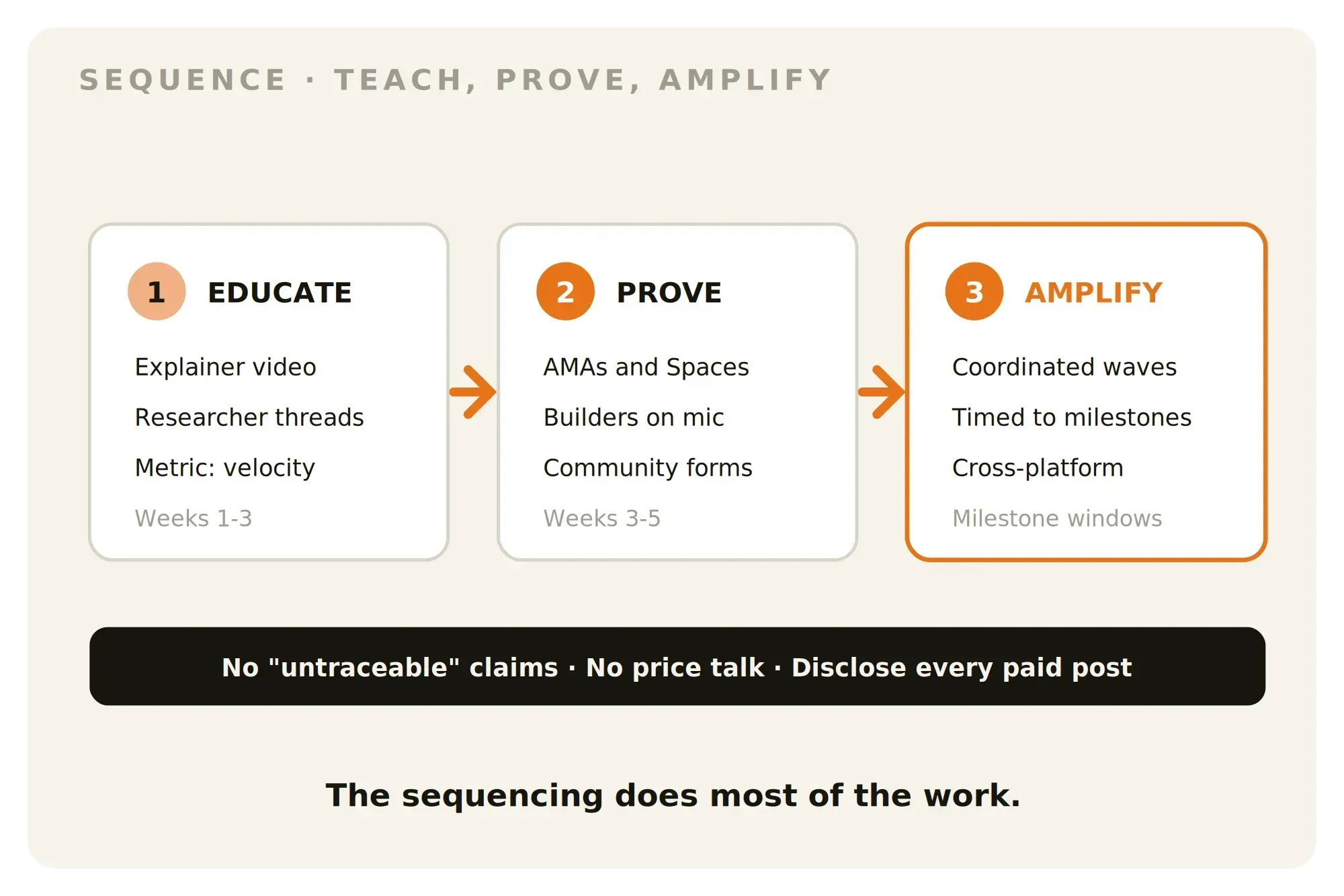
Phase one: seed the education layer.
- Two to three weeks of explainer content from technically credible creators.
- Long-form video walkthroughs, researcher threads, written breakdowns.
- The goal is comprehension, and the metric is velocity on that content, not conversions.
Phase two: build credibility in public.
- AMAs and Spaces with your actual builders, hosted by creators whose audiences showed up in phase one.
- Privacy buyers want to hear engineers answer hard questions live.
- This is also where community channels start converting attention into members.
Phase three: amplify around real milestones.
- Coordinated waves timed to protocol upgrades, mainnet dates, and ecosystem news, sequenced across platforms so each wave feeds the next.
- For infrastructure teams, this maps cleanly onto pre-launch and launch-window timelines.
Three messaging rules apply throughout, and they're not optional.
Never claim "untraceable" or promise protection from law enforcement.
Never talk price, in any phase, in any creator's mouth.
Always disclose paid partnerships, prominently, because in this sector disclosure builds trust rather than costing it.
Budget honestly too. Education-first campaigns need enough volume to produce readable data, and the statistical floor for that hasn't changed.
A handful of posts into the most skeptical audience in crypto tells you nothing.
The Window is Open, and It's Specific
Privacy has the rarest thing in crypto marketing: a true story that's getting better.
Usage growing, regulation clarifying, infrastructure maturing.
The projects that win the sector will be the ones whose distribution matches that maturity, run by media professionals who can teach, not hype accounts who can only cheer.
Lever's roster already includes the zk researchers, DeFi analysts, and long-form educators this sector needs, vetted on-chain, coordinated in waves, measured on velocity.
If you're building in privacy, tell us what you're shipping and we'll design the campaign around it.
If you want the general mechanics first, the campaign guide covers how we structure creator marketing from brief to report.
The sector grew up. The marketing has to as well.