
How to Manage 40+ Crypto KOLs Without Killing Your Marketing Team
Running effective KOL campaigns can be a nightmare. Let your marketing team focus on the big picture, and have Lever handle everything else.

The search that probably brought you here went something like "hire web3 KOLs," "web3 influencer campaigns," or "how to hire crypto KOLs."
Well, we're glad you found Lever first, because running your own marketing campaign with multiple KOLs is not what you expect.
Usually, founders and marketing leads who set out to hire crypto influencers to help promote their projects almost always approach this feat as a procurement problem:
- Find creators
- Agree on a price
- Get posts.
That mental model holds for the first few hires. Past that, it's bananas.
- At 20 KOLs, you have a workflow problem.
- At 40, you have a logistical nightmare.
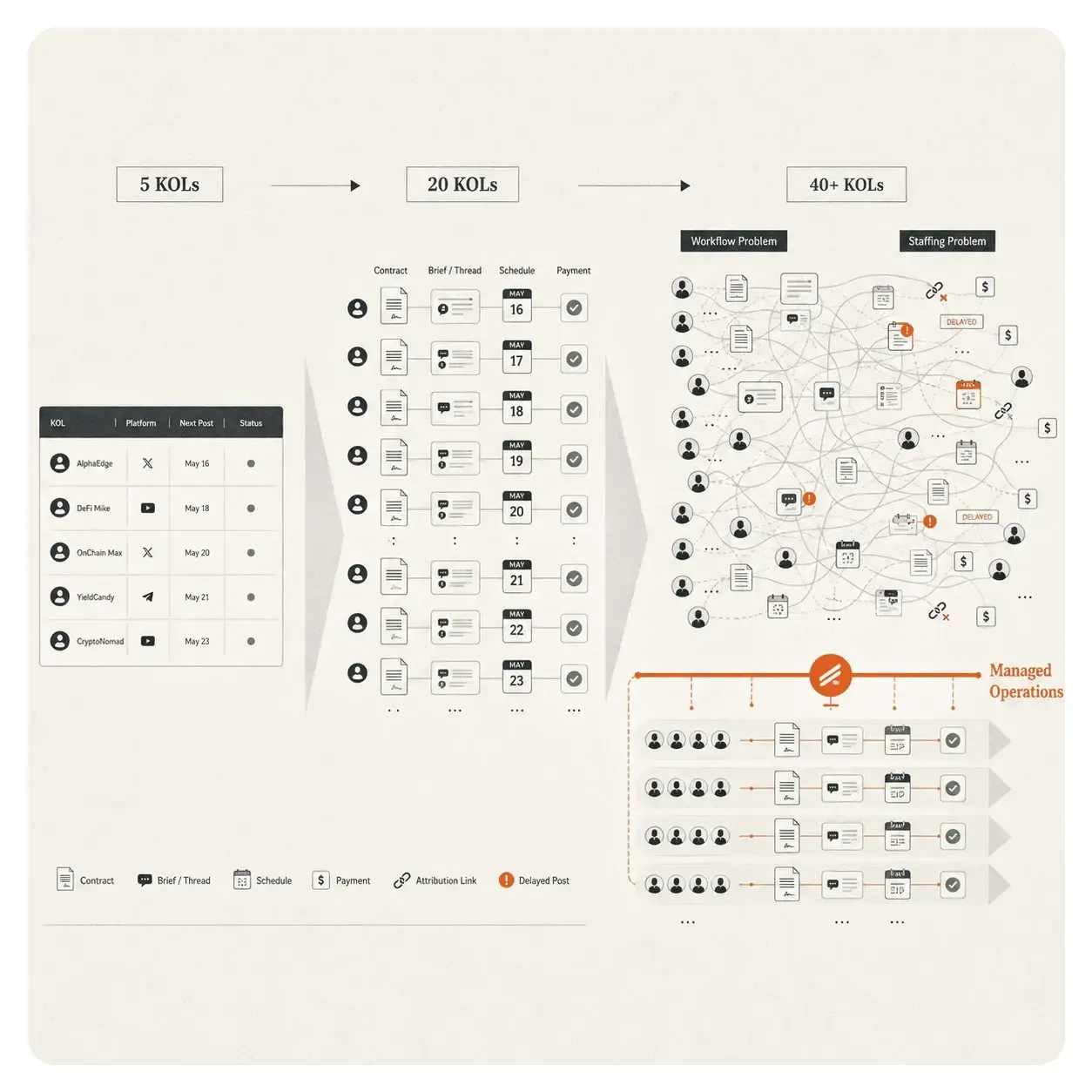
The article below is an honest account of what scaling a KOL roster actually demands.
If you're planning to build this function in-house, read it first. If you'd rather skip the part where the operations break, talk to us about hiring crypto influencers before you start.
Hiring Your First Wave of Crypto KOLs: Why It Feels Like You've Got This
Your first five KOL hires feel manageable:
- You build a shortlist by checking follower counts and looking for engagement that doesn't smell like bots.
- Then, you reach out and 1/10 creators respond to your requests.
- After that, you negotiate, send contracts, and start coordinating what they'll do and when they'll post.
The founder is still close enough to catch problems early. It feels like marketing is happening, and at most you need one spreadsheet to keep things tidy.
But even at five creators, just the vetting is more time-consuming than it looks.
Do you really know how well your newly hired creators perform?
The Crypto Twitter creators who will anchor your first wave are operating in an environment where follower counts have been inflated systematically, where engagement can be farmed through comment pods and follow-loops, and where audience overlap between apparently different accounts often runs above 60%.
Two of your newly hired creators might even be the same guy running multiple accounts.
Good vetting catches this.
It requires reference points that only come from watching this space across many campaigns, and most in-house teams doing their first round don't have them yet (we've already vetted 500+ creators, so you don't have to).
Twitter KOL Campaigns Require Volume, and Volume Requires Coordination You Can't Fake
Twitter is a volume game.
One or two posts from well-known accounts can generate buzz, but to actually move the needle on X you need a coordinated wave of KOLs posting within a tight window, with messaging that builds on itself rather than competing for attention.
Coordinating KOLs at scale is where most in-house teams hit the wall they didn't see coming.
InfoFi promised a shortcut by flooding the timeline with volume, rewarding anyone who tweeted the right things, and calling it distribution.
But InfoFi is dead with X's new updates, and good riddance.
Read More: Why InfoFi Failed & Why Lever.io Works
 Lever.io
What InfoFi actually produced was a wall of low-quality posts from accounts that had burned through their credibility doing the same thing for twenty other projects that week.
- Projects got tweets.
- They didn't get new users.
- Timelines filled with garbage.
Audiences learned to scroll past anything that smelled like a campaign, which was everything.
Instead of that noise, Lever gets you real presence on X through planned and coordinated campaigns.
The difference shows up in the replies, the retweets, and the wallets that actually connect.
Why Web3 Influencer Campaigns Start Breaking Between 5 and 20 KOLs
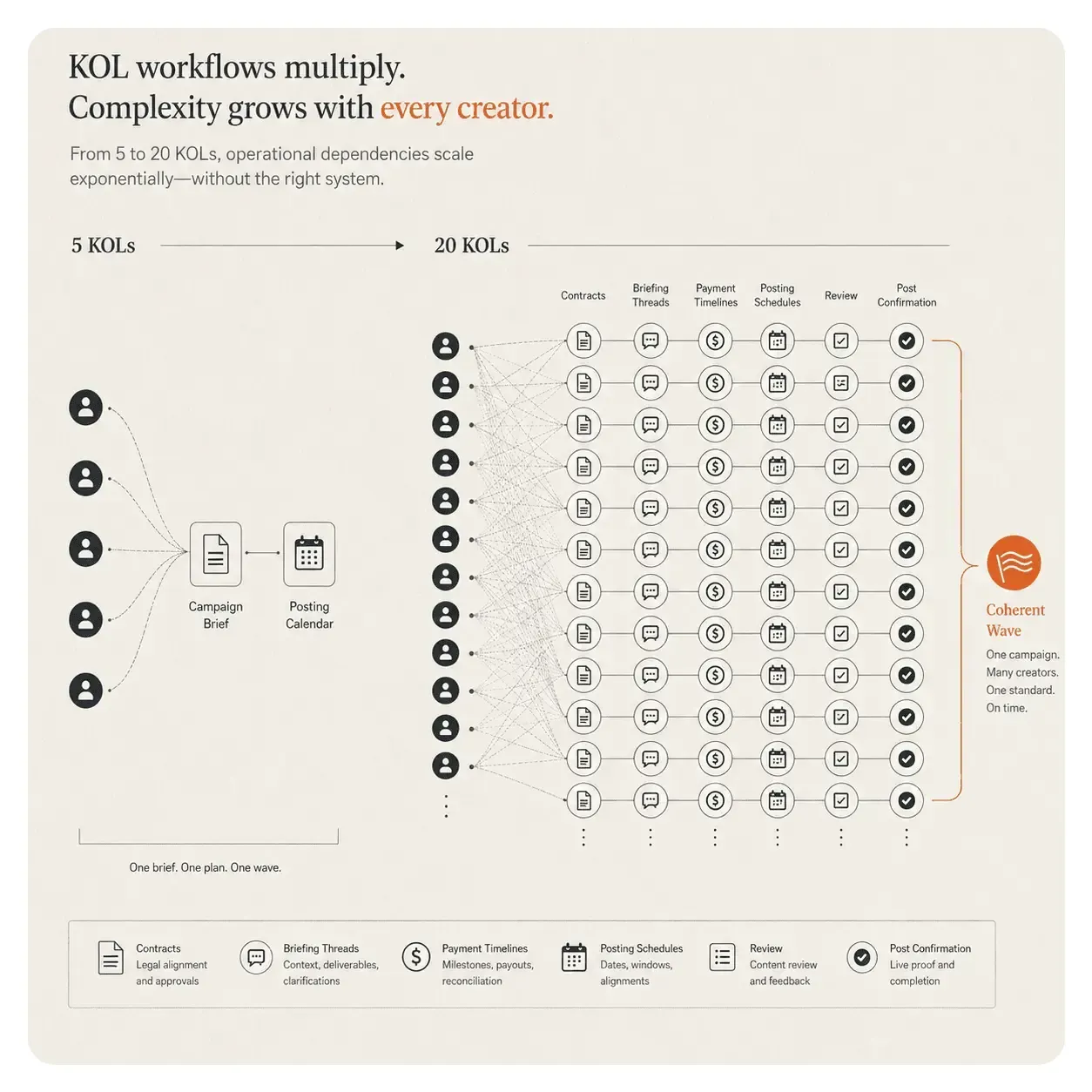
As you can see in the diagram above, between hiring 5 and 20 KOLs, something changes.
Each new creator you add multiplies the complexity of every existing workflow.
A roster of 20 means 20 separate contracts, 20 briefing threads, 20 payment timelines, and 20 posting schedules that need active sequencing.
The campaign has to land as a coherent wave, not a dump-then-silence pattern.
Brief Drift and Payment Fragmentation: Where In-House Marketing Teams Lose Nights
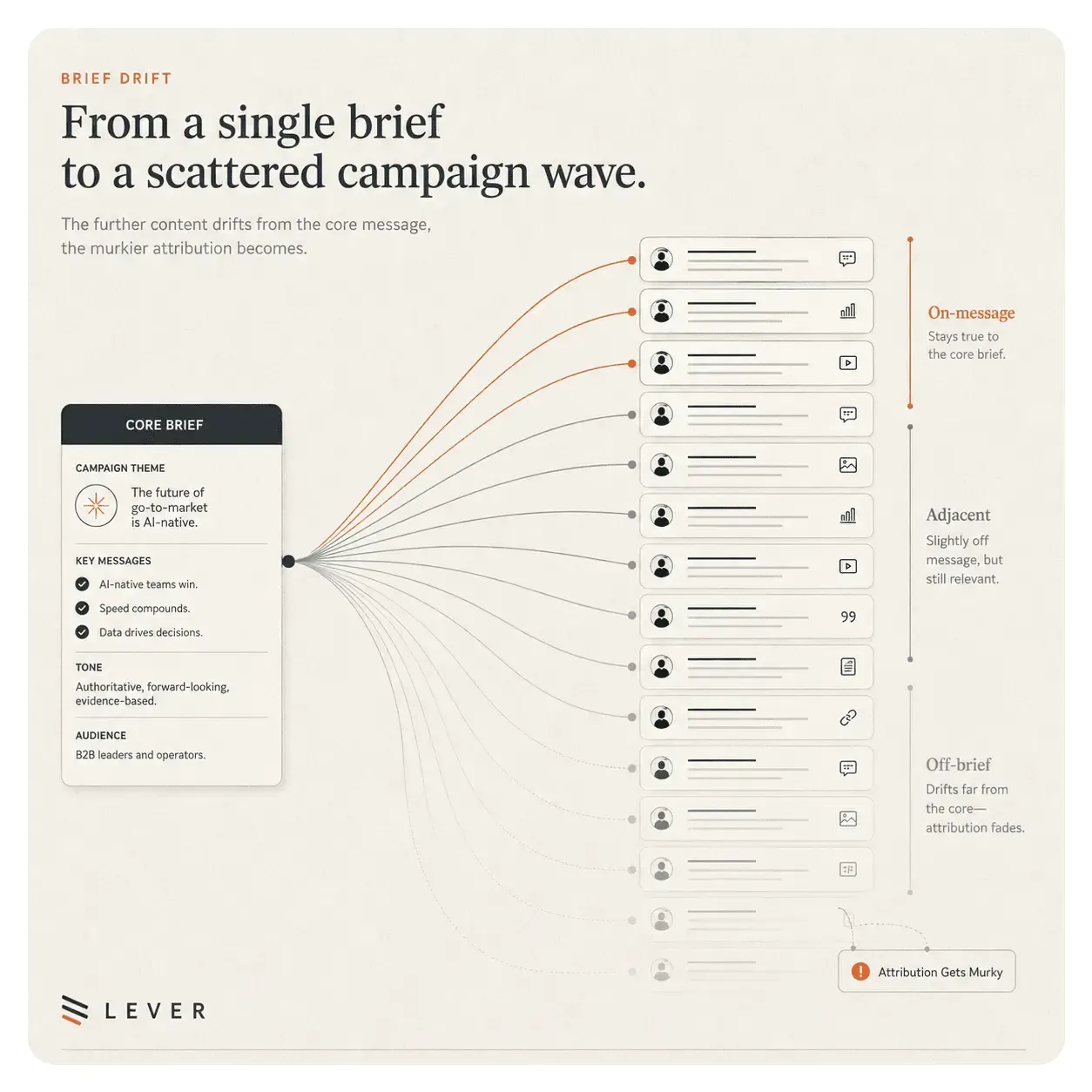
Brief drift is a quiet killer:
- You write a central campaign brief and share it across 15 creators.
- Your Telegram fills with "OK, boss, will get it done."
- Half the posts aren't live within your precious 1-hour algo-window.
By the time the posts land, three are on-message, four are adjacent, and the rest have defaulted to whatever format performs on their channel.
The founder asks why this wave didn't move the needle the way the first one did.
Payment fragmentation runs alongside that.
Chasing 15 payment confirmations while coordinating the next brief while fielding questions from three creators who didn't fully read the last one is not a task that sits cleanly inside a single job description.
This is where in-house teams start losing nights.
Or, and this is the path most teams eventually take, you hand it to us before the nights get long. Talk to us about your next campaign.
Managing 40+ Crypto KOLs: The Failure Modes Nobody Talks About in Public
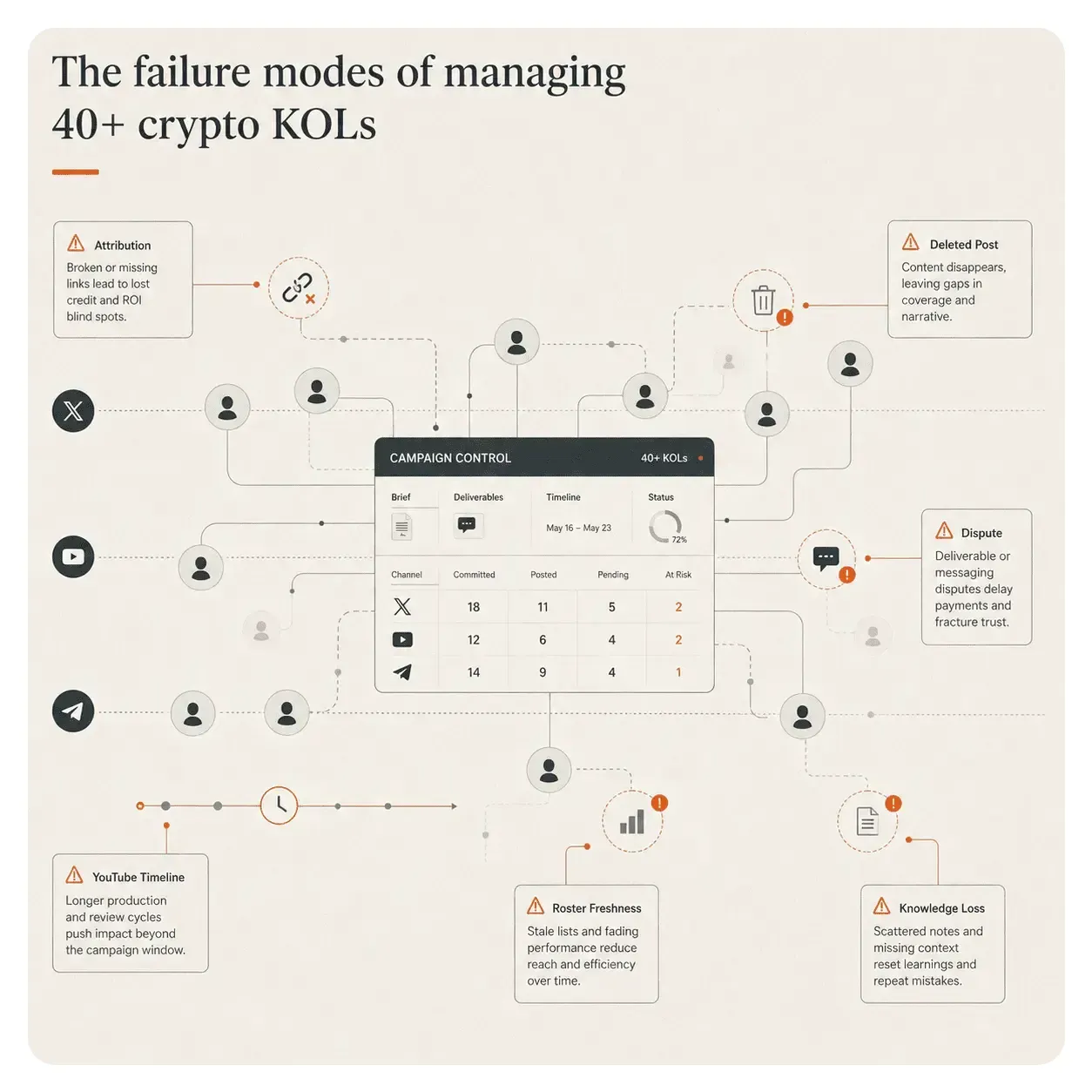
Past 40 KOLs, the failure modes that were manageable at 20 start to interact with each other.
Here's what the collapse actually looks like:
- Deleted posts break campaigns mid-flight. During the two weeks around a token launch, when pressure is highest, a creator pulling their post requires immediate triage: find a replacement, write a fresh brief, negotiate terms, confirm the slot, while the original campaign window is still open.
- Deliverable disputes have no clean owner. A creator posts something that technically fulfills the brief but misses the intent badly. At 5 KOLs, a founder handles this personally. At 40, there is no clean owner.
- YouTube timelines run on a different clock. Long-form YouTube deliverables have their own cadence with earlier briefing windows, longer review cycles, and significantly more specific creative direction than X posts. Managing that in parallel with everything else is a full operations role.
- Roster freshness erodes quietly. The creator who drove real results six months ago may be coasting now. If no one is monitoring performance continuously, you find out at post-time when the numbers don't move.
- Institutional knowledge walks out the door. The one person holding it all together is working unsustainable hours. When they leave, everything they know about which creators are reliable, which managers need extra lead time, and which accounts are currently overexposed goes with them.
If you've reached this point, you don't need a better system. You need a team that's been running this for years. That's what we do. See what working with us looks like.
The Niche Problem: DeFi, GameFi, and Layer 1 Creators Don't Operate the Same Way

The niche complexity makes it worse.
- KOLs who work primarily with DeFi protocols operate on entirely different cadences than creators in other verticals. Audience expectations, posting frequency, and the type of content that converts are not the same across niches.
- GameFi creators, who run by entirely different rhythms, need briefing that accounts for their community culture, which rewards entertainment and competition over protocol explainers.
- Layer 1 narratives demand a different kind of roster altogether, one that indexes on technical credibility rather than community energy. The creators who move the needle there are often not the loudest accounts.
- And then there's the platform layer. A campaign running across Twitter, YouTube, and Telegram simultaneously requires format-specific briefing for each. The post that works on X reads badly as a Telegram note and lands as filler on YouTube.
What We've Built Across 300+ Web3 KOL Campaigns So You Don't Have To
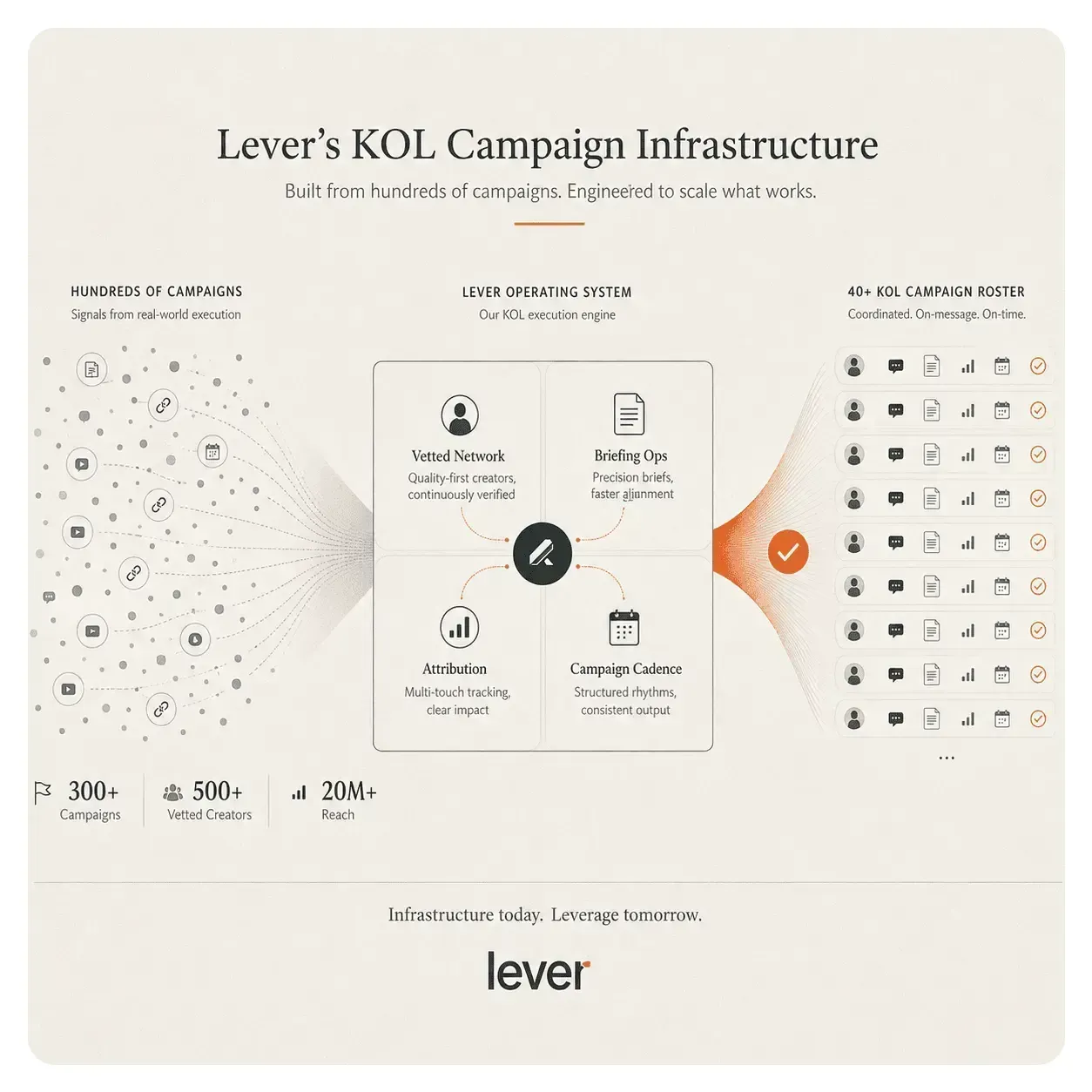
After 300+ campaigns and work with 500+ vetted creators reaching a combined audience of over 20 million, we've built the operational infrastructure that this work actually requires.
A Pre-Vetted Creator Network With Live Performance Data, Not Six-Month-Old Rankings
It starts with the roster.
We maintain a pre-vetted creator network across tiers, niches, and platforms, with active performance data on who is driving results right now, not six months ago.
When we build a campaign roster, we're not sourcing from scratch.
We know which creators are currently reliable, which ones carry audience overlap problems, and which accounts are in a strong moment for the type of project we're promoting.
That knowledge compounds over campaigns in a way that a team starting from scratch cannot replicate quickly.
A Briefing Operation That Keeps 40 Different Voices Sounding Coherent
Keeping 40 voices coherent across a campaign without producing posts that all sound like they were written by the same person requires a briefing operation refined over hundreds of campaigns.
We know what level of creative direction produces consistency without killing the authenticity that makes crypto KOL content work.
The briefs we write work better than a first-time client's brief because we have the experience creating them.
Getting Real Quality Out of YouTube and TikTok Creators Takes More Than a Brief and a Deadline
When you start working with video creators, you discover quickly that hiring a KOL and producing good content are two different jobs.
Left to their own devices, creators default to the minimum deliverable.
Not because they're lazy (okay, maybe some are a bit lazy), but because they're optimizing for their own workflow, and the path of least resistance produces content that checks the box without moving anyone.
Getting a genuinely strong YouTube video or TikTok out of a creator requires a sustained back-and-forth that most brands aren't set up to run:
- Talking point sequencing.
- Feedback on a first cut that's specific enough to actually change it.
- Understanding what the creator's audience responds to and shaping the brief around that, not around what your internal team thinks sounds good.
Suddenly, you've become a production studio on top of everything else you're already managing.
Lever has the expertise to get the most out of video creators without burning the relationship.
We know how to brief for long-form and short-form, how to give feedback that lands, and how to push creators toward content that converts rather than content that simply gets filed as a deliverable.
An Operational Cadence That Doesn't Depend on Your Team to Keep Moving
The cadence we run doesn't depend on the client's team to drive it.
We handle creator relationships directly, manage disputes, monitor posting schedules, and own the day-to-day coordination.
Clients don't need a dedicated KOL ops hire to work with us. That's intentional.
This is what running a crypto KOL operation end-to-end actually looks like. We handle it.
Two Ways to Run a Web3 KOL Program at Scale
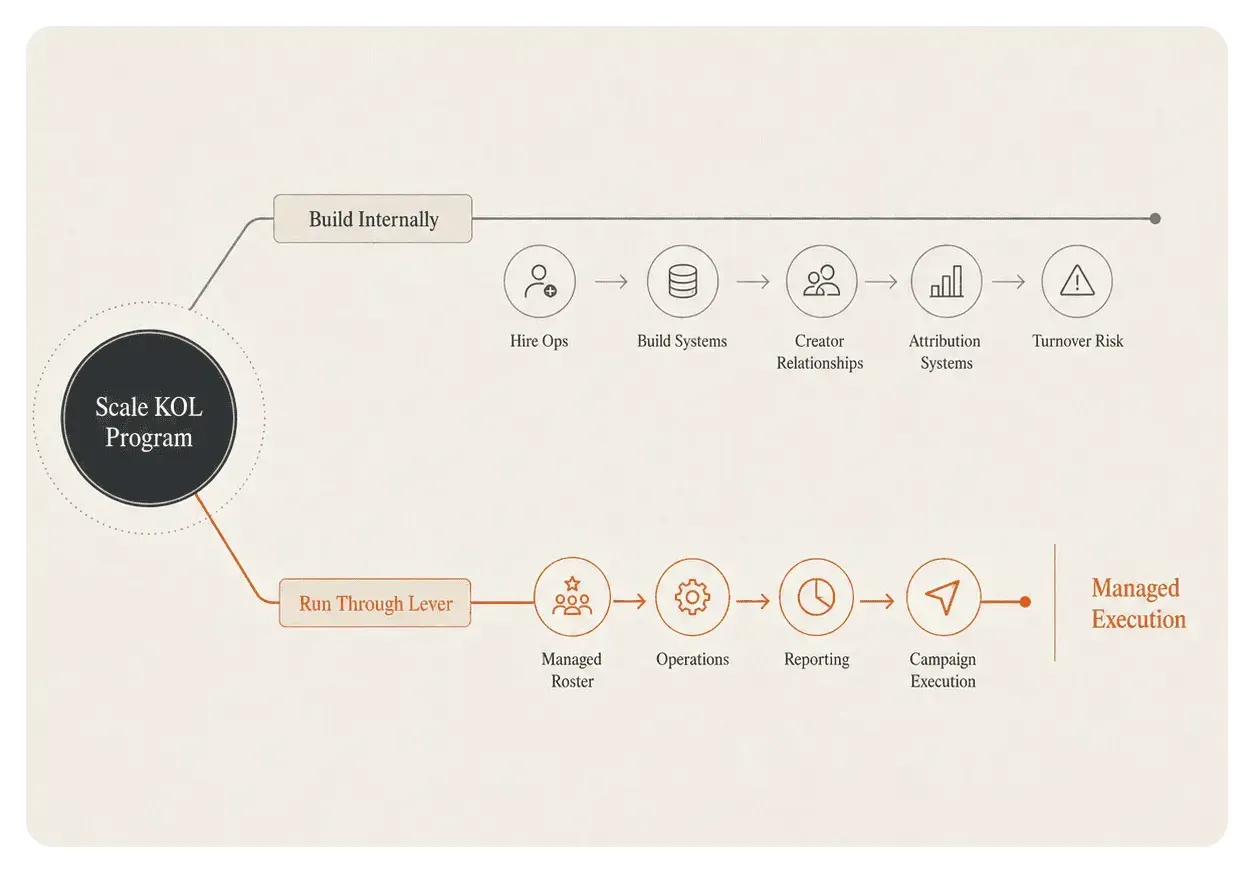
There are two ways to approach this.
The first is to build a team internally.
Hire people who've done this before (they're not easy to find), build vetting infrastructure, establish creator relationships from scratch, and plan for the turnover that hits every in-house team running this kind of work.
It's possible. It takes longer and costs more than the spreadsheet suggests at the start.
Or hire Lever and we do everything for you.
The second is to hand the entire Web3 marketing function to a team that's done it 300+ times, skip the phase where operations break and get rebuilt, and put your team's attention on the work that only your team can do.
Most of the projects that come to us have tried some version of the first path. They're not usually looking back.
Book a strategy call and let's talk about your next campaign.